
 Posted by
 When my sister was diagnosed with schizophrenia, I was terrified. I knew nothing about the illness except the stereotypes I had seen in movies. Violent. Unpredictable. Hopeless. I treated her like a stranger, walking on eggshells, waiting for something terrible to happen. Then her treatment team introduced us to psychoeducation, and everything changed.
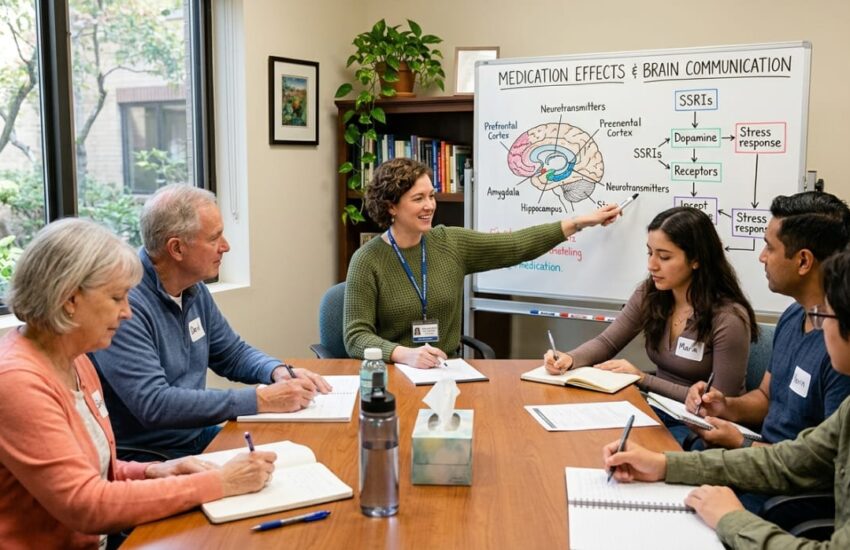
Psychoeducation is a structured approach to teaching patients and families about a mental health condition. For schizophrenia, it covers symptoms, treatment options, warning signs, coping strategies, and communication skills. The goal is to replace fear with understanding and blame with collaboration.
The first thing I learned was what schizophrenia is not. It is not split personality. It is not caused by bad parenting. It is not a character flaw. Schizophrenia is a serious brain disorder that affects how a person thinks, feels, and behaves. The average age of onset is late teens to early twenties for men and late twenties to early thirties for women. My sister was twenty-two when her first psychotic episode landed her in the hospital.
The core symptoms include positive symptoms, which are psychotic behaviors not seen in healthy people. Hallucinations, usually auditory voices that others cannot hear. Delusions, fixed false beliefs that persist despite evidence. Disorganized thinking, which makes speech hard to follow. Negative symptoms include loss of motivation, social withdrawal, and reduced emotional expression. Cognitive symptoms affect memory, attention, and executive function.
I learned that my sister was not choosing to hear voices. The voices were real to her. Fighting her delusions was like fighting gravity. She needed medication, not lectures.
Psychoeducation taught me the critical importance of medication adherence. Antipsychotic medications reduce symptoms and prevent relapse, but side effects can be difficult. Weight gain, sedation, and movement disorders are common. Many people stop taking their medication because of these side effects. Understanding why my sister might want to stop helped me support her through the discomfort instead of judging her.
We also learned to recognize early warning signs of relapse. Sleep changes. Increased suspiciousness. Withdrawal from activities. Odd speech or behavior. Before psychoeducation, I saw these signs as personality flaws. Afterwards, I saw them as signals to call her doctor. Early intervention can prevent full relapse and hospitalization.
Communication skills were another vital component. I learned to avoid arguing with delusions. Trying to reason my sister out of her beliefs only made her cling to them harder. Instead, I learned to validate her feelings without validating the delusion. “I hear that you’re scared. That sounds really hard.” Not “There’s no one following you.” She felt heard without feeling attacked.
I also learned to use simple, concrete language. People with schizophrenia may have difficulty processing complex information during active symptoms. Short sentences. One instruction at a time. Lots of repetition. “Time for lunch.” Not “Would you like to come to the dining room now because lunch is being served?” Small changes made communication possible.
Psychoeducation also addressed my own mental health. Family members of people with schizophrenia are at higher risk for depression, anxiety, and burnout. The education included self-care strategies. Setting boundaries. Taking breaks. Attending support groups. I could not help my sister if I collapsed. Learning to care for myself was not selfish. It was necessary.
The education was not a one-time event. It happened over months, in group sessions with other families and individual meetings with her treatment team. We revisited topics as my sister’s condition changed. What worked during stable periods did not work during active psychosis. The ongoing support was essential.
Today, my sister is stable. She takes her medication. She attends therapy. She lives in supported housing and works part-time at a library. She still hears voices sometimes, but she has learned to ignore them. She still has hard days. But she has a life.
Psychoeducation did not cure her schizophrenia. Nothing can. But it transformed our family from terrified bystanders into informed advocates. We stopped fighting each other and started fighting the illness together.
There is so much more to learn about supporting a loved one with schizophrenia. Our website is filled with articles on psychoeducation, medication, and family support. Head over and explore, because knowledge really is power.
References
Pitschel-Walz, G., et al. (2011). Psychoeducation for schizophrenia. *Cochrane Database of Systematic Reviews, 2011*(6), CD004745. https://pmc.ncbi.nlm.nih.gov/articles/PMC4170907/
Xiang, M., et al. (2020). Clinical practice guidelines for psychoeducation in psychiatric disorders. *Journal of Clinical Psychiatry, 81*(2), 1–10. https://pmc.ncbi.nlm.nih.gov/articles/PMC7001357/
González-Pinto, A., et al. (2008). Psychoeducation in schizophrenia: New developments and approaches in the field. *Current Opinion in Psychiatry, 21*(2), 168–172. https://pubmed.ncbi.nlm.nih.gov/18332665/
Delhi Mind Clinic. (2024, December 18). *5 essential aspects of psychoeducation for schizophrenia*. https://www.delhimindclinic.com/psychoeducation-for-schizophrenia/
Ramos-Brieva, J., et al. (2025). The effect of psychoeducation on clinical symptoms, adherence, insight, self-esteem, and social autonomy in schizophrenia. *Frontiers in Psychiatry, 16*, 11871247. https://pmc.ncbi.nlm.nih.gov/articles/PMC11871247/