
 Posted by
 I have always been someone who could talk my way through anything. I could analyze my feelings, explain my history, and articulate my struggles with precision. But when my therapist suggested sandplay therapy, I was skeptical. Playing with toys in a sandbox felt childish, not therapeutic. I thought I was beyond something so simple. I was wrong.
Sandplay therapy is a nonverbal, therapeutic intervention that uses a sandbox, miniature figures, and water to create scenes that reflect a person’s inner world. It is often used with children, but it is also deeply effective for adults who have experienced trauma, loss, or emotional blocks that resist verbal expression. The sand tray becomes a safe space to externalize what cannot be said.
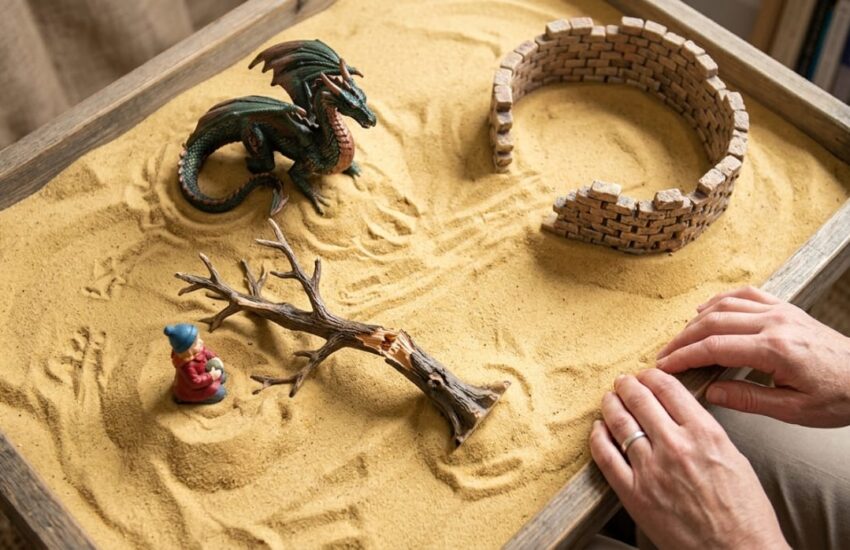
The first time I tried it, I felt ridiculous. I looked at the shelves of miniature figures, animals, houses, trees, people, mythical creatures, bridges, and fences, and I did not know what to choose. My therapist told me not to think. She said to let my hands choose. I reached for a dragon, a castle, a small child, and a broken tree. I arranged them in the sand without conscious thought. When I stepped back, I was startled by what I had created. It was a scene of isolation and fear, with the child trapped behind a wall. I had not planned that. But as soon as I saw it, I knew it was me.
The therapist did not interpret the scene for me. She did not tell me what it meant. She simply asked me to describe it, to tell the story of what I saw. I started talking about the child behind the wall, and suddenly I was talking about my own childhood, my own fear of being seen, my own need for protection. The scene was a mirror, and I was finally ready to look into it.
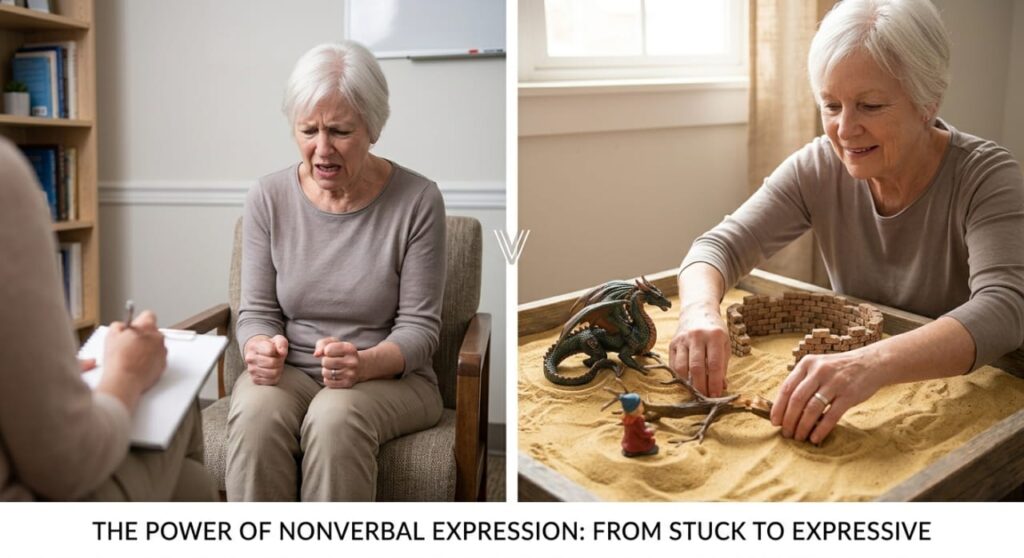
Sandplay therapy creates a safe distance between the client and their experience. The sand tray is a projective technique that externalizes the internal landscape. When a client creates a scene, the scene becomes something separate from them. They can observe it, describe it, and interact with it without being overwhelmed by it. That distance allows deeper exploration than traditional talk therapy often permits.
The sand itself is a powerful element. It is tactile, grounding, and neutral. It can be shaped, smoothed, and reshaped, reflecting the fluid and changeable nature of the psyche. Water can be added to create moisture, representing the emotional depth and complexity of the inner world. The process is guided by the client, not the therapist, making it a self-directed form of exploration.
Sandplay is especially effective for trauma survivors. Traumatic memories are often stored in the right hemisphere of the brain, which is nonverbal and sensory. Talk therapy, which relies on the left hemisphere, can struggle to access these deeply encoded experiences. Sandplay bypasses language entirely, allowing the sensory and emotional components of trauma to emerge and be processed in a safe, contained space.
I continued sandplay for several months. Each session, I created a new scene. Some were chaotic. Some were peaceful. Some were violent. Over time, patterns emerged. The child appeared less often. The walls came down. Bridges appeared between isolated figures. I did not consciously plan these changes. They just happened as I continued to play. But looking back, I can see the progression. I was healing in a language I did not even know I spoke.
Sandplay therapy also helped me access my dreams more clearly. The figures and scenes from my sessions often appeared in my sleep, providing additional material for processing. I felt more connected to myself, more grounded, and more capable of expressing emotions that had previously felt locked inside.
If you are someone who has struggled with traditional talk therapy, or if you are looking for a deeper way to explore your inner world, sandplay therapy might be worth exploring. You do not need to be artistic or creative. You do not need to know what you are doing. You just need to be willing to let your hands choose.
There is so much more to learn about sandplay and other expressive therapies. Our website is filled with articles on nonverbal healing, trauma recovery, and finding the right therapist. Head over and explore, because sometimes, what cannot be said can still be expressed.
References
Roesler, C. (2019). Sandplay therapy: An overview of theory, applications and evidence base. *The Arts in Psychotherapy, 64*, 80–92.
Roesler, C. (2020). Sandplay therapy: An overview of theory, applications and evidence base. *International Journal of Play Therapy*.
Institute of Child Psychology. (n.d.). *Sandplay therapy: An overview of theory, applications and evidence base*. https://www.instituteofchildpsychology.com/app/uploads/2021/06/Sandplay-article-accepted-manuscript.pdf
International Association of Analytical Psychology. (n.d.). *Sandplay therapy*. https://iaap.org/wp-content/uploads/2020/01/Roesler-Sandplay-studies-AIP.pdf
Sandplay Association. (n.d.). *Resources*. https://sandplayassociation.com/resources/