

 Posted by
 I had been in therapy for years. I had learned to identify my triggers, challenge my thoughts, and practice mindfulness. But when I experienced a panic attack, my body would still hijack me. My heart raced, my palms sweated, and my breathing became shallow. I knew what was happening, but I could not stop it. My therapist suggested biofeedback, and I was skeptical. I did not need more data about my anxiety. I needed relief. I was wrong.
Biofeedback is a type of therapy that uses sensors attached to your body to measure physiological responses like heart rate, muscle tension, skin temperature, and brainwave activity. These measurements are displayed on a monitor in real time. By watching the feedback, you learn to recognize the physical signs of stress and practice techniques to bring them under conscious control.
The first session was strange. I sat in a comfortable chair with sensors attached to my fingers, chest, and forehead. A screen in front of me displayed a simple game: a sailboat that moved across a digital ocean. I was told to relax. The boat moved faster when my heart rate was elevated and slower when I was calm. I stared at the screen, trying to slow the boat down. It felt impossible at first. My heart raced just from the pressure of trying to calm down.
But my therapist guided me through breathing exercises. Breathe in for four, hold for four, exhale for four, hold for four. As I followed her instructions, I watched the boat slow down. I was not imagining it. I could see the change. The feedback was immediate and undeniable. I learned that the longer exhale activates the parasympathetic nervous system, which is responsible for rest and relaxation. The screen was showing me in real time what a state of calm felt like in my body.
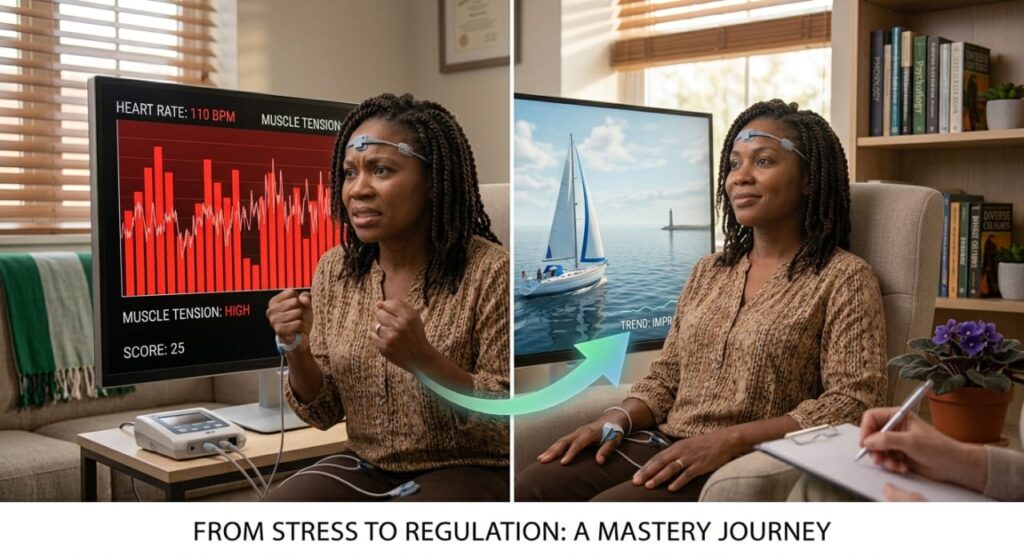
Biofeedback works because it makes the invisible visible. Most of us are unaware of our physiological responses. We know we are stressed, but we do not know that our heart rate has been elevated for hours or that our muscles are chronically tense. The feedback provides objective, measurable data that helps us connect physical sensations to emotional states. Once we see the data, we can take action to change it.
Over several sessions, I learned to recognize the subtle signs of stress before they escalated. I noticed that my breathing became shallow before my anxiety spiked. I noticed that my forehead muscles tensed when I felt frustrated. I learned to use relaxation techniques at the first sign of these changes, before they spiraled into a full panic attack. The feedback helped me become more aware of my body, and that awareness gave me control.
Biofeedback is used to treat a wide range of conditions. It is effective for anxiety, stress, and panic disorders. It is also used for chronic pain, high blood pressure, tension headaches, migraines, and TMJ. In some cases, it is used to support recovery from brain injuries and to manage symptoms of PTSD. My therapist told me about a patient with chronic migraines who learned to warm her hands using thermal biofeedback. By consciously increasing blood flow to her hands, she was able to reduce the frequency and severity of her headaches. The connection between mind and body is real, and biofeedback makes that connection tangible.
One of the most surprising benefits of biofeedback was the improvement in my sleep. I had been waking up multiple times a night, often with racing thoughts. I learned to use a relaxation response technique before bed, which helped lower my heart rate and muscle tension. I tracked my progress over several weeks and watched as my quality of sleep improved. I was not just sleeping more; I was sleeping better.
Biofeedback is not a quick fix. It requires practice and consistency. The skills you learn in a session need to be reinforced at home. My therapist sent me home with a simple heart rate variability monitor and a breathing app. I practiced for ten minutes each day. Over time, the skills became automatic. I stopped needing the monitor because I could feel the changes in my body. I had internalized the feedback.
If you have tried therapy and still feel disconnected from your body, biofeedback might be the missing piece. It is a tool that empowers you to take control of your physiology. It is not a replacement for talk therapy. It is a complement to it.
There is so much more to learn about the mind-body connection and evidence-based approaches to healing. Our website is filled with articles on biofeedback, stress management, and mental health. Head over and explore, because the feedback you need might be right in front of you.
References
Lehrer, P. M., Gevirtz, R., & Vaschillo, E. (2017). Biofeedback. Annual Review of Psychology, 68, 499–528. �
Frank, D. L., Khorshid, L., Kiffer, J. F., Moravec, C. S., & McKee, M. G. (2010). Biofeedback in medicine: Who, when, why and how? *Mental Health in Family Medicine, 7*(2), 85–91.
Sielski, R., Rief, W., & Glombiewski, J. A. (2017). Efficacy of biofeedback in anxiety disorders: A systematic review and meta-analysis. *Psychological Medicine, 47*(3), 362–374.
Hammond, D. C. (2011). What is neurofeedback: An update. *Journal of Neurotherapy, 15*(4), 305–336.
Arns, M., Heinrich, H., & Strehl, U. (2014). Evaluation of neurofeedback in ADHD: The long and winding road. *Biological Psychology, 95*, 108–115.