
 Posted by
 The call came in at 3 AM. A multi-vehicle accident on the highway. I was a paramedic then, and I had seen bad scenes before. But this one was different. A family. Children. I did my job. I stayed calm. I followed protocol. And then I went home and fell apart. I could not sleep. I could not eat. I kept seeing their faces. I thought I was losing my mind. What I did not know was that I was experiencing a normal reaction to an abnormal event, and there was a structured way to help me recover.
Critical Incident Stress Management, often called CISM, is a comprehensive, systematic, and multicomponent approach to managing the psychological aftermath of traumatic events. It was developed specifically for first responders, emergency personnel, and others who are exposed to critical incidents as part of their work. The goal is not to prevent people from feeling anything. The goal is to prevent normal stress reactions from becoming chronic, disabling conditions like post-traumatic stress disorder.
A critical incident is any event that has the power to overwhelm a person’s usual coping mechanisms. It does not have to be a mass casualty event. It can be a line-of-duty death, a particularly gruesome scene, a call involving a child, or a situation that hits too close to home. What makes an incident critical is not the size of the event. It is the impact on the individual.
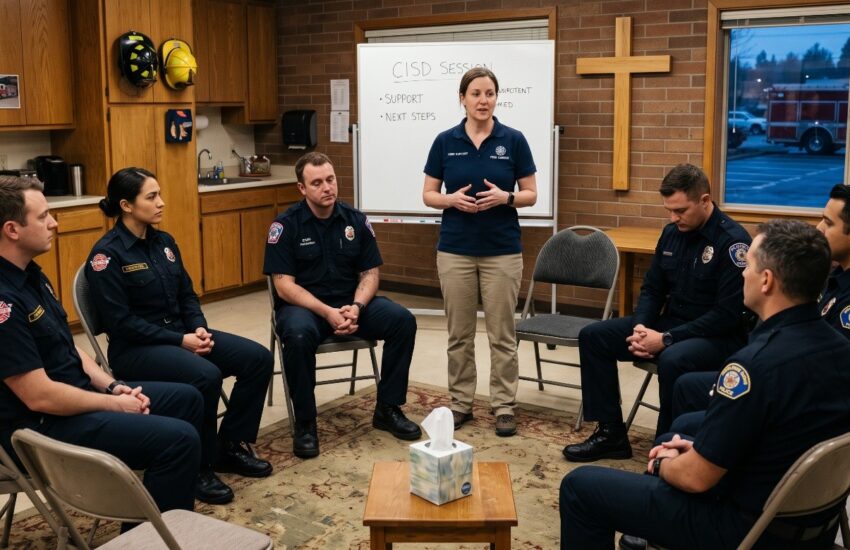
I attended a debriefing three days after the highway accident. I was reluctant. I did not want to talk about it. I did not want to cry in front of my colleagues. But I went. And it changed everything. The facilitator did not force anyone to speak. He simply created a safe space. He explained that our reactions were normal. He told us what to expect in the coming weeks. He gave us permission to feel what we were feeling. And then he let us talk. One by one, my colleagues shared their experiences. Some cried. Some were angry. Some were silent. But we were together. And in that togetherness, I found something I had lost. I found that I was not alone.
CISM is not a substitute for therapy. It is not a treatment for PTSD. It is a form of psychological first aid. It is designed to mitigate the impact of a traumatic event and to identify individuals who may need more intensive support. It is also designed to build resilience and to strengthen the bonds of a team. Research on CISM has been mixed, with some studies showing benefits and others showing limited effect. But for many first responders, including myself, it was a lifeline.
The key components of CISM include pre-incident education, which prepares personnel for the possibility of critical incidents. It includes individual crisis intervention, which provides one-on-one support. It includes family support, because families are affected too. And it includes follow-up, because the effects of trauma are not always immediate.
If you work in a high-stress field, or if you have experienced a critical incident, I want you to know that your reactions are normal. You are not weak. You are not broken. You are human. CISM is not a cure. But it is a bridge. It is a way to get from the immediate aftermath of a traumatic event to the longer-term support you might need. And sometimes, that bridge is the difference between surviving and thriving.
There is so much more to learn about trauma, resilience, and supporting those who serve on the front lines. Our website is filled with articles on mental health, crisis intervention, and peer support. Head over and explore, because no one should have to carry the weight alone.
References
Everly, G. S., Jr., Flannery, R. B., Jr., & Mitchell, J. T. (2000). Critical incident stress management: A review of the literature. *Psychiatric Quarterly, 71*(1), 1–15. [https://doi.org/10.1023/A:1004600316477](https://doi.org/10.1023/A:1004600316477)
Mitchell, J. T. (1983). When disaster strikes: The critical incident stress debriefing process. *Journal of Emergency Medical Services, 8*, 36–39.
Pack, M. J. (2013). Critical incident stress management: A review of the literature with implications for social work. *Australian Social Work, 66*(4), 512–528. [https://doi.org/10.1080/0312407X.2012.708762](https://doi.org/10.1080/0312407X.2012.708762)
Regel, S. (2007). Post-trauma support in the workplace: The current status and practice of critical incident stress management. *Occupational Medicine, 57*(6), 411–416. [https://doi.org/10.1093/occmed/kqm071](https://doi.org/10.1093/occmed/kqm071)
Alexander, D. A., & Klein, S. (2009). First responders after disasters: A review of stress reactions, at-risk, vulnerability, and resilience. *Prehospital and Disaster Medicine, 24*(2), 87–94.
Critical Incident Stress Working Group. (2010). *Guidelines for managing critical incident stress and associated debriefing*. [https://library.dbca.wa.gov.au/static/FullTextFiles/627608.pdf](https://library.dbca.wa.gov.au/static/FullTextFiles/627608.pdf)
International Society for Traumatic Stress Studies. (n.d.). *Critical incident stress management: A new era in crisis intervention*. [https://istss.org/critical-incident-stress-management-a-new-era-in-crisis-intervention/](https://istss.org/critical-incident-stress-management-a-new-era-in-crisis-intervention/)