

 Posted by
 I used to think visualization was wishful thinking. I knew about athletes who imagined winning races and musicians who rehearsed performances in their heads. But I thought it was just a positive thinking trick, a nice idea that did not actually change anything. Then I tried it for myself, and my entire perspective shifted.
Visualization is a technique that involves actively imagining a desired outcome in vivid detail, engaging all of your senses to make the mental image as real as possible. It is based on the principle that the brain does not always distinguish between a real experience and a vividly imagined one. When you visualize an action, the same neural pathways are activated as when you perform the action. The brain rehearses the experience, building connections and strengthening patterns that support success.
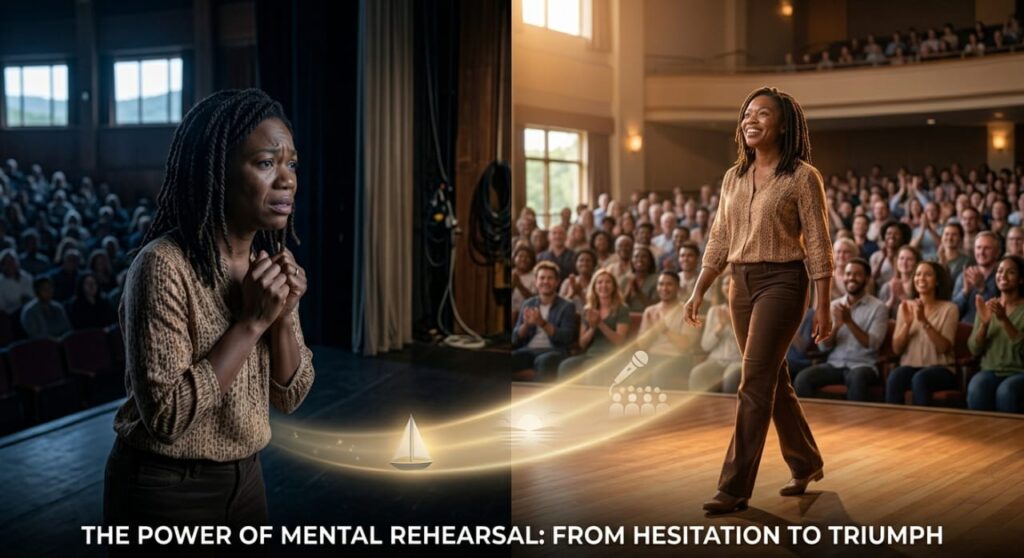
The first time I used visualization intentionally was before a major presentation. I had prepared the content thoroughly, but I was still terrified. I would freeze up and forget my points or stumble over my words. My therapist suggested I take five minutes the night before to close my eyes and imagine the presentation going perfectly. I could not imagine it. I tried to picture myself walking into the room, but I kept seeing myself freezing up.
She told me to start small. First, imagine walking into the room with confidence and looking the audience in the eye. I practiced that simple scene again and again until it felt real. I imagined the room, the lighting, the faces of the people in the front row. I imagined the sound of my own voice, clear and steady. I imagined the feeling of answering a tough question with ease and seeing people nod in agreement. I made the scene as detailed as possible. Then I moved on to the next part. I kept going until I had visualized the entire presentation.
When the actual presentation arrived, something shifted. I still felt nervous, but I also felt prepared. I had already been there in my mind. I had already seen myself succeed. I walked into the room, looked at the audience, and the words came easily. It was not perfect, but it was far better than anything I had done before. Visualization did not eliminate my anxiety; it gave me something to hold onto when my anxiety tried to take over.
Visualization works for performance, but it is also essential for healing and personal growth. Studies show that visualization can reduce anxiety, improve mood, and even support physical recovery from injury. It helps you build a positive mindset and focus on what you want, not what you fear.
I also learned to use visualization in my daily life. When I faced a difficult conversation, I would mentally rehearse it first. When I tried to break a bad habit, I would visualize myself choosing a healthier behavior. When I needed comfort, I would close my eyes and imagine a place of safety and peace. These small practices accumulated into a profound shift in my outlook. I became more present, more resilient, and more capable of handling challenges.
Visualization is not a replacement for action. It is a complement to it. You cannot visualize your way to a better life without also putting in the work. But visualization can give you the clarity and confidence you need to take the next step. It helps you create a mental map, and then you can start walking toward it.
If you have a challenge ahead, take a few minutes today to visualize yourself succeeding. Be specific. Engage all your senses. Notice the sounds, the feelings, the atmosphere. Do it once, then do it again. Over time, your mind will begin to believe what you are showing it.
There is so much more to learn about using visualization and other mental techniques to support your growth. Our website is filled with articles on goal setting, mindfulness, and personal development. Head over and explore, because if you can see it, you can start living it.
References
Roesler, C. (2025). Visualization psychotherapy for common mental disorders. *Psychodynamic Practice*. https://www.tandfonline.com/doi/full/10.1080/09515070.2025.2560407
Israelashvili, M. (2018). The increasingly prominent role of visualization in counseling: Examples and implications for school counseling. *Journal of School Counseling*.
Thomas, N. (2016). Mental imagery in cognitive behavioral therapy: A practitioner’s guide. *Journal of Cognitive Psychotherapy*.
Kremer, J., Moran, A., & Kearney, C. J. (2019). *Pure sport: Sport psychology in action*. Routledge.
Jeannerod, M. (1995). Mental imagery in the motor context. *Neuropsychologia, 33*(11), 1419–1432.
Crum, A. J., & Langer, E. J. (2007). Mind-set matters: Exercise and the placebo effect. *Psychological Science, 18*(2), 165–171.