
 Posted by
 When my nephew lost his father, he stopped talking. Not entirely, but almost. He answered questions with single words. He never initiated conversation. The adults around him kept asking him to share his feelings, but he couldn’t. He didn’t have the words for the gaping hole in his life. His therapist suggested play therapy, and I was skeptical. Playing felt disrespectful, too light for something so heavy. I was wrong.
Play therapy is a structured therapeutic approach that uses play to help children express what they cannot yet verbalize . For grieving children, play provides a safe distance from overwhelming emotions. A child who cannot say “I’m angry that my dad died” might smash a clay figure or knock over a block tower. That smashing is communication. That destruction is expression.
My nephew’s first few sessions looked like chaos. He ran around the room, touched everything, knocked things over. The therapist didn’t stop him or redirect him. She just observed and reflected. “You seem like you have a lot of energy today.” “You knocked that tower down very hard.” She wasn’t judging. She was witnessing. He started to feel seen.
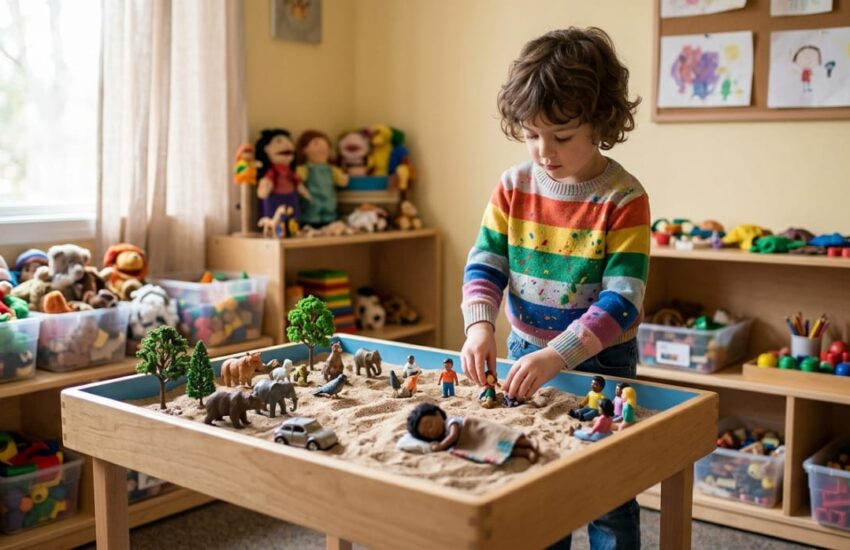
Sand tray therapy is a common play therapy technique for grief. The child chooses miniature figures and arranges them in a sandbox. The scene they create reflects their inner world. My nephew filled his tray with monsters, a knocked-over tree, and a small figure lying on its side. He didn’t explain it. He didn’t need to. The therapist said, “It looks like something bad happened here.” He nodded. That was his story.
Art therapy is another form of play therapy. Children draw what they cannot say. My nephew drew a house with no door. Then a figure standing alone. Then a dark cloud over everything. Each drawing was a sentence in a language without words. The therapist didn’t interpret or analyze. She just asked gentle questions. “Tell me about this figure.” “What is happening in this picture?” He started to talk, not about his feelings directly, but about the characters in his drawings
Puppets give children a safe voice. A child who cannot say “I’m scared” might make a puppet say it. The distance of the puppet makes the emotion bearable. My nephew used a small lion puppet to talk about being brave when he felt terrified. He wasn’t ready to say “I’m terrified.” But the lion could say it. That was progress.
Bibliotherapy uses books to process grief. The therapist reads a story about a character experiencing loss, then invites the child to talk about the character’s feelings. It is safer to talk about a fictional rabbit losing its mother than to talk about your own father. My nephew listened to several grief-themed books before he could say a single word about his own loss. The stories gave him a vocabulary.
Grieving children often regress developmentally. A child who was toilet-trained might start wetting the bed. A child who could use full sentences might return to baby talk. Play therapy meets the child where they are, not where they “should” be. My nephew wanted to be rocked like a baby during several sessions. The therapist rocked him. That regressive need was real and valid.
Play therapy also helps children regain a sense of control. Grief makes children feel powerless. Death happened to them, and they could not stop it. In the playroom, the child is in charge. They decide what to play, how long to play, when to stop. That autonomy is healing. My nephew spent three sessions just telling the therapist what not to do. “Don’t touch that.” “Don’t sit there.” It was annoying. It was also him reclaiming power.
The therapist also involved the family. She taught us how to play with my nephew at home without interrogating him about his feelings. No “how are you doing?” No “do you miss your dad?” Just simple presence. “I’m here.” “Let’s build something.” “Let’s draw.” The pressure to talk lifted. And when it lifted, he finally started talking.
After six months of play therapy, my nephew drew a new picture. A house with a door. A figure standing inside. Sun in the corner. He pointed to the figure. “That’s me,” he said. “I’m okay.” Not happy. Not healed. But okay. That was enough.
There is so much more to learn about supporting grieving children. Our website is filled with articles on play therapy, childhood grief, and finding the right therapist. Head over and explore, because sometimes the deepest healing happens when we stop talking and start playing.
References
Lowenstein, L. (n.d.). *How to help bereaved children in play therapy*. RH Play Therapy Training. https://www.rhplaytherapytraining.com/blog/how-to-help-bereaved-children-in-play-therapy
Play Therapy Melbourne. (2020, June 23). *Grief, loss, bereavement and play therapy*. https://www.playtherapymelbourne.com/grief-loss-bereavement-and-play-therapy/
Synergetic Play Therapy Institute. (2021, December 2). *Grief and loss in play therapy*. https://synergeticplaytherapy.com/grief-and-loss-in-play-therapy/
AuthoraCare. (n.d.). *How play therapy helps grieving children*. https://www.authoracare.org/how-play-therapy-helps-grieving-children
UC Davis Health. (2022, August 16). *Activities for grieving children and families*. https://health.ucdavis.edu/children/patient-education/bereavement-activities