
 Posted by
 My brother’s addiction consumed our family for a decade. We tried everything. Interventions, ultimatums, cutting him off, bailing him out. Nothing worked. Every conversation turned into a fight. Every holiday ended in tears. We loved him, but we couldn’t reach him. We were stuck. Then a therapist suggested family therapy. Not just for my brother. For all of us. I was skeptical. The addict was the problem, right? Fix him, fix the family. But the therapist explained that addiction is a family disease. Everyone adapts to it. Everyone develops coping patterns that may unintentionally enable use. Everyone gets hurt.
Family therapy for substance use disorders treats the whole system, not just the identified patient. It’s not about blaming parents or shaming siblings. It’s about understanding how the family operates and finding healthier ways to function.
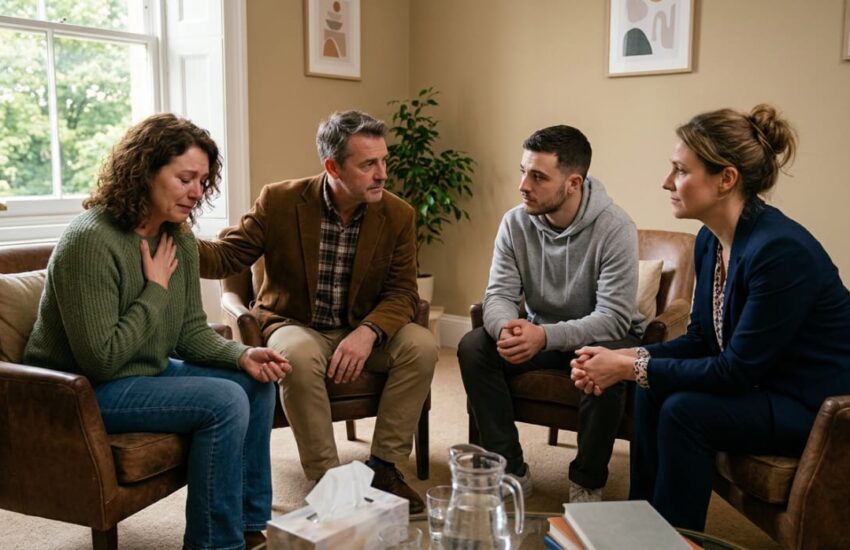
The first session was brutal. My mother cried. My father raged. My brother defended. The therapist didn’t take sides. She simply observed and asked questions. “When he uses, how do you respond?” “When you respond that way, how does he feel?” “What are you afraid will happen if you stop?”
We learned that my mother’s rescuing kept my brother from facing consequences. She paid his rent, posted bail, and called employers to explain his absences. She thought she was loving him. She was actually removing his reasons to stop.
My father had withdrawn completely. He refused to talk about the addiction. He left the room when the subject came up. He thought he was protecting himself. He was actually isolating my brother from any male support.
My brother, in turn, used to manage family conflict. When my parents fought about him, he used. When my mother cried, he used. When my father walked out, he used. His addiction wasn’t just about getting high. It was also his coping mechanism for family pain.
The therapist taught us new communication skills. No more accusations. No more ultimatums. Instead, “I” statements. “I feel scared when you don’t come home.” “I feel helpless when I don’t know how to help you.” These statements didn’t blame. They just shared feelings. My brother could hear them without shutting down.
We also learned about boundaries. Not punitive boundaries, loving boundaries. My mother agreed to stop paying my brother’s rent. She agreed to stop lying to his employer. She agreed to let him experience the natural consequences of his use. She cried when she made those promises. But she kept them.
My father agreed to stay in the room during difficult conversations. He agreed to share his own feelings instead of hiding them. He agreed to attend Al-Anon meetings. He didn’t have to fix his son. He just had to show up. My brother agreed to treatment. Not because we forced him, but because the family dynamic had changed. The rescuing stopped. The withdrawal stopped. The blame stopped. He had no one to rebel against. He only had himself.
Family therapy didn’t cure my brother’s addiction overnight. He relapsed twice during treatment. But the relapses were shorter and less destructive. He called us instead of disappearing. He went back to meetings instead of giving up. Three years later, my brother is sober. My parents are in couples therapy, finally addressing the wounds they ignored for decades. We have holidays again. Not perfect holidays, we still have hard moments, but we’re together. We talk. We laugh. We don’t blame.
Family therapy didn’t just save my brother. It saved my family. We stopped being a system organized around addiction and started being a system organized around love. That shift made recovery possible. If you love someone with a substance use disorder, don’t wait for them to hit bottom. Seek family therapy for yourself. You can’t control their use, but you can change how you respond. And sometimes, that change is the wake-up call they need.
There’s so much more to learn about healing families affected by addiction. Our website is filled with articles on family therapy, boundary setting, and self-care for loved ones. Head over and explore, because recovery is possible for everyone, not just the person using substances.
References
McCrady, B. S. (2022). Effects of family therapy for substance abuse: A systematic review of the evidence from 2010 to the present. *Family Process, 61*(4), 1180–1198. https://onlinelibrary.wiley.com/doi/full/10.1111/famp.12841
Substance Abuse and Mental Health Services Administration. (n.d.). *Chapter 3—Family counseling approaches*. https://www.ncbi.nlm.nih.gov/books/NBK571088/
Substance Abuse and Mental Health Services Administration. (n.d.). *TIP 39: Substance use disorder treatment and family therapy* [PDF]. https://ntcrc.org/wp-content/uploads/2022/01/TIP_39_Substance_Use_Disorder_Treatment_and_Family_Therapy.pdf
Drugfree.org. (2023, September 25). *Family therapy for addiction*. https://drugfree.org/article/family-therapy-for-addiction/
American Addiction Centers. (2026, May 3). *Family therapy for substance use disorders and addiction recovery*. https://americanaddictioncenters.org/therapy-treatment/family-therapy