
 Posted by
 The first time my mother got lost on the way to the bathroom, I chalked it up to a bad day. The second time, I felt a flicker of concern. By the tenth time, when she stood in the hallway, confused and tearful, unable to recognize the door she’d walked through hundreds of times, I realized the problem wasn’t her memory. It was the environment she was living in.
My mother had moved into a perfectly nice nursing home. The hallways were clean, the staff were kind, and her room was cozy. But that facility, like so many others, was designed for efficiency, not for brains that process information differently. The long, identical corridors. The indistinguishable doors.
The glare on the floor looked like water. The noisy dining room where she couldn’t focus on eating. None of it was malicious. It was just designed for the wrong people. That’s when I began learning about implementing a dementia-friendly environment in nursing homes and discovered that the physical space itself can be a powerful tool for healing, or a source of constant confusion and distress.
Dementia changes how the brain interprets the world. Vision, depth perception, and contrast sensitivity decline. The ability to filter out irrelevant stimuli diminishes. Wayfinding becomes challenging. Abstract symbols, like restroom signs, lose meaning.
What looks like a clear, logical layout to you or me can be an incomprehensible maze to someone with dementia. A dementia-friendly environment works with these changes, not against them. It reduces confusion, supports independence, and minimizes the agitation that comes from constantly feeling lost or overwhelmed.
Let me start with the simplest and most transformative element: wayfinding. In traditional nursing homes, corridors look identical. Doors look identical. Even residents who have lived there for months can struggle to identify their own room.
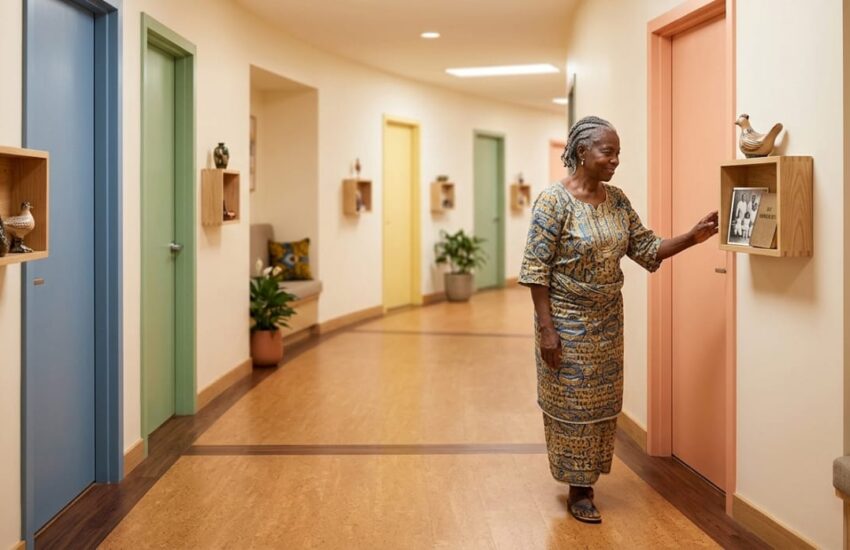
My mother’s facility eventually painted each resident’s door a different color and installed small memory boxes outside, shadow boxes filled with personal mementos, photos, and objects from their past. My mother’s box held a small ceramic bird, a photo of her childhood home, and a worn copy of her favorite book. She couldn’t read the room number, but she could recognize her bird. She could find her way home.
Color and contrast matter enormously. People with dementia often lose contrast sensitivity, making it difficult to distinguish between similar tones. A white toilet against a white floor becomes invisible. A white plate on a white tablecloth disappears.
My mother’s facility learned to use high-contrast colors deliberately, dark toilets against light floors, colored plates on contrasting placemats, bold tape on the edges of steps. These small changes reduced falls, increased independence, and made eating less frustrating.
Lighting is another critical factor. Aging eyes need more light to see clearly, but harsh overhead lighting can create glare and shadows that confuse and frighten. My mother’s facility installed softer, ambient lighting with reduced glare.
They used curtains to control natural light, reducing the harsh shadows that could look like holes or obstacles. They kept hallways well-lit at night so residents who wandered could see where they were going, reducing the disorientation of waking in darkness.
Noise is often overlooked in nursing home design, but it’s a major source of distress for people with dementia. Overstimulation from constant intercom announcements, clattering dishes, loud conversations, and beeping equipment can overwhelm already compromised brains.
Implementing a dementia-friendly environment means creating quiet zones, reducing unnecessary noise, and designing spaces that absorb rather than amplify sound. My mother’s facility designated certain areas as “quiet neighborhoods” where noise was minimized and residents could retreat when overwhelmed.
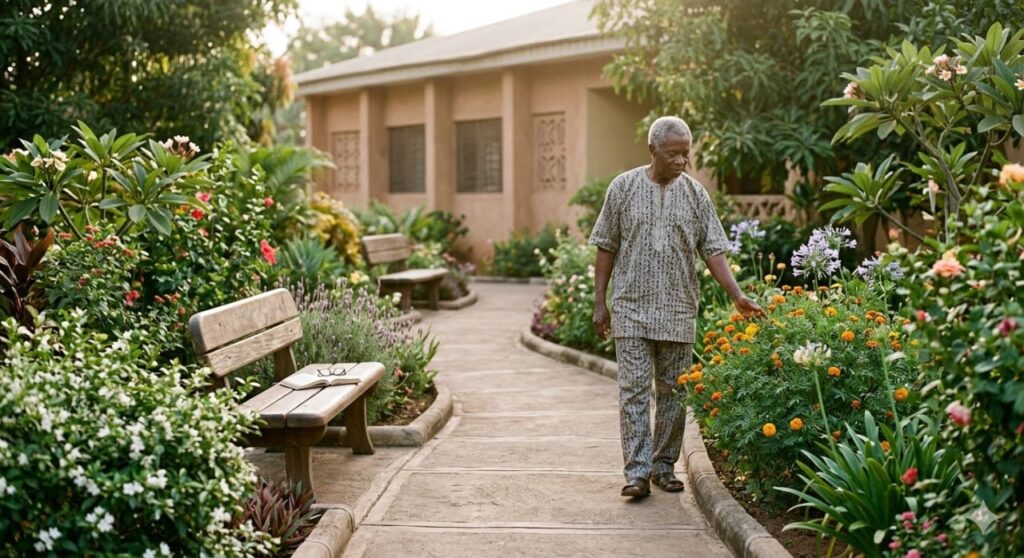
The outdoors matters too. Access to nature reduces agitation, improves mood, and supports circadian rhythms that regulate sleep. But a standard patio isn’t necessarily dementia-friendly. My mother’s facility created a secure garden with enclosed wandering paths, looping routes that allowed residents to walk freely without encountering dead ends or locked gates.
They planted fragrant flowers that stimulated positive memories. They provided comfortable seating in shaded areas. For my mother, that garden became a sanctuary. She walked those paths for hours, calm and content, her restlessness channeled into purposeful movement.
Inside, common areas need careful thought. Large, open spaces can feel intimidating and disorienting. My mother’s facility broke up their main common room into smaller, cozier seating areas, each with a different character. One area had a fireplace and armchairs.
Another had tables for activities. Another had a television tucked into a cabinet, only visible when in use. This reduced the overwhelming sensory input and gave residents choices about where to spend their time. Dining is particularly challenging for people with dementia.
The traditional nursing home dining room, large, noisy, bustling, can make it impossible to focus on eating. My mother’s facility shifted to smaller, family-style dining areas where residents ate at the same time each day with familiar faces. They used simple place settings with only essential items, reducing decision fatigue. They served food that was easy to recognize and eat. Weight loss stabilized. Mealtime stress plummeted.
Bathrooms need special attention. People with dementia often struggle to recognize toilet facilities or understand how to use them. Clear visual cues, a brightly colored toilet seat, an open door showing the toilet, simple pictograms, can make the difference between independence and incontinence. Grab bars that contrast with the wall are easier to see.
Non-slip flooring reduces fall risk. My mother’s facility even installed bidet toilets, which made hygiene easier for residents who could no longer manage wiping independently. Perhaps the most important principle I learned is that dementia-friendly environments prioritize autonomy over safety whenever possible. Traditional facilities often lock doors, hide exits, and restrict movement in the name of protection.
But this constant restriction creates its own distress. A truly dementia-friendly environment uses design to reduce risk while maximizing freedom, secure gardens instead of locked units, wandering paths instead of dead ends, and visual cues instead of verbal corrections.
The evidence supporting these changes is overwhelming. Facilities that implement dementia-friendly design report fewer falls, reduced use of antipsychotic medications, lower rates of agitation and aggression, improved sleep, better nutrition, and higher resident and family satisfaction. Staff morale improves too, because caring for calm, oriented residents is less exhausting than managing constant distress.
My mother spent her final three years in a facility that embraced these principles. She still had dementia. She still forgot who I was sometimes. But she stopped getting lost. She stopped crying in hallways. She ate better, slept better, and seemed, in some fundamental way, more at peace. The environment couldn’t cure her, but it could hold her. It could make her feel safe in a world that had become increasingly confusing and frightening.
If you have a loved one in a nursing home, or if you’re considering placement, look at the environment with fresh eyes. Are the hallways confusing or clear? Can you find your way without signs? Does the space feel calm or chaotic? Can residents wander safely? Are there quiet places to retreat? The answers will tell you whether the facility sees dementia as a problem to manage or as a different way of experiencing the world, one that deserves accommodation, respect, and thoughtful design.
And if you’re advocating for change in a facility that isn’t there yet, start small. Suggest memory boxes outside doors. Ask about contrast and color. Inquire about lighting and noise. Sometimes the smallest adjustments make the biggest difference.
There’s so much more to learn about creating environments where people with dementia can thrive, and our website is filled with resources on this topic and many others. From design principles to communication strategies to family advocacy, we’re here to help you navigate every stage of the dementia journey. Head over and explore, because the more we understand, the better we can care for the people who once cared for us.
References
van Buuren, L. P. G., & Mohammadi, M. (2022). *Dementia-friendly design: A set of design criteria and design typologies supporting wayfinding*. *HERD: Health Environments Research & Design Journal, 15*(2), 92–112. https://doi.org/10.1177/19375867211043546
NHS England. (2021). *Dementia-friendly health and social care environments* (Health Building Note 08-02-01). Retrieved from https://www.england.nhs.uk/wp-content/uploads/2021/05/HBN_08-02-1.pdf
de Boer, B., et al. (2019). *The physical environment of nursing homes for people with dementia: Traditionally assessed and user-assessed aspects*. *Building Research & Information, 47*(3), 281–296. https://doi.org/10.1080/09613218.2018.1527694
Centre for Excellence in Universal Design. (2015). *Universal design guidelines: Dementia friendly dwellings*. Retrieved from https://universaldesign.ie/uploads/publications/UD_Guidelines-Dementia_Friendly_Dwellings-2015-Introduction_2023-11-10-092702_qo.pdf
Dementia Australia. (2024, September 25). *Designing dementia-friendly care environments*. Retrieved from https://www.dementia.org.au/professionals/designing-dementia-friendly-care-environments