

 Posted by
 I thought journaling was for other people. For writers, for teenagers, for people who had time I didn’t have. The idea of sitting down with a notebook felt self-indulgent, almost embarrassing. What would I even write? I didn’t have deep thoughts. I had to-do lists and anxiety.
Then my therapist suggested I try it. I resisted for weeks. But she kept bringing it up, gently, each session. Finally, I bought a cheap spiral notebook and a pen. I told myself I’d write for five minutes. Just five. That was seven years ago. I still journal almost every day. And I’ve learned that journaling isn’t about being profound. It’s about being honest.
The first thing I discovered was how much mental clutter I was carrying. Thoughts I didn’t know I had were swirling in my head, taking up space, causing low-grade anxiety. The moment I put them on paper, they lost some of their power. The act of writing forced me to slow down, to name what I was actually feeling instead of just vaguely feeling it.
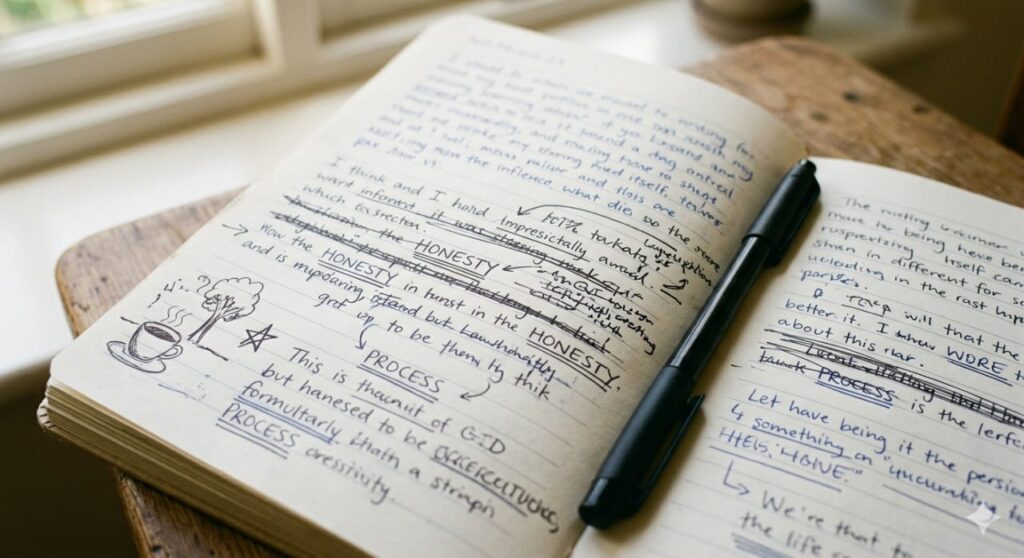
My first entry was a rant. Work stress, relationship tension, money worries, all of it dumped onto the page. When I finished, my shoulders dropped. I hadn’t solved anything. But I had emptied the pressure valve. The thoughts were no longer trapped inside me.
Over time, my journaling evolved. I started noticing patterns. Every Sunday night, I wrote about work anxiety. Every time I argued with my partner, I wrote about feeling misunderstood. Seeing these patterns on paper helped me address their root causes instead of just reacting to symptoms. I realized I wasn’t sleeping enough, which made everything harder. I noticed that certain people drained my energy consistently.
Journaling also became a tool for processing hard emotions. When my father was diagnosed with cancer, I couldn’t talk about it. The words wouldn’t come. But I could write. I filled pages with fear, anger, grief, memories, questions I couldn’t ask out loud. Writing didn’t take away the pain, but it gave me a place to put it. The journal held what I couldn’t.
I also learned to use journaling for problem-solving. When I felt stuck, I’d write about the problem as if I were advising a friend. What would I tell someone in this situation? The answers came more easily on paper than they ever did in my head. Writing externalized the issue, made it something I could examine instead of something I was drowning in.
Gratitude journaling sounded cheesy to me. But my therapist pushed me to try it. Every night, I wrote down three things that went well. Some days, they were small, a good cup of coffee, a kind text from a friend. Some days, they were bigger, a promotion, a healing conversation. Over weeks, this practice rewired my brain. I started noticing good things in real time because I knew I’d be writing them down later. My default perspective shifted from what was wrong to what was right.
Morning pages changed my routine. I write three pages first thing, before checking my phone or email. This practice, borrowed from Julia Cameron, clears my head for the day ahead. I dump out whatever is rattling around, dreams, worries, plans, nonsense. By the time I finish, I feel lighter, more focused, ready for what comes.
I learned that journaling doesn’t have to be daily to be valuable. Some weeks I write every day. Some weeks I write once. The practice bends to my life, not the other way around. What matters is that when I need it, it’s there.
The privacy of journaling matters. I don’t share my journal with anyone. Knowing no one will read it frees me to be completely honest. I can write things I’d never say aloud—ugly thoughts, petty grievances, wild dreams. The page holds them without judgment.
Journaling has also helped me track my mental health over time. When I feel like I’m not making progress, I flip back through old entries. I see how far I’ve come. I read about crises that resolved, fears that didn’t materialize, problems I solved. The journal is evidence that I can survive hard things.
If you’re new to journaling, start small. Five minutes. Three sentences. A bullet list if paragraphs feel too formal. Don’t worry about handwriting, grammar, or coherence. The journal is for you, not for anyone else. There’s no wrong way to do it.
Try different approaches. Stream of consciousness, where you write whatever comes without stopping. Prompt-based journaling, using questions like “What am I avoiding?” or “What do I need right now?” Gratitude lists. Future planning. Letter writing to your past or future self. See what resonates. Don’t pressure yourself to write when you don’t want to. A journal isn’t a homework assignment. It’s a tool. Use it when it helps. Set it aside when it doesn’t. The notebook will wait.
I still have anxiety. I still face hard days. But now I have a tool that helps me navigate them. The page catches what my mind can’t hold alone. It clarifies, calms, and connects me to myself. You don’t need to be a writer to keep a journal. You just need to be a person with thoughts worth noticing. And you are. Every single one of them deserves to be seen.
There’s so much more to learn about using writing for mental health. Our website is filled with articles on journaling techniques, expressive writing, and therapeutic practices. Head over and explore, because the most important conversation you’ll ever have is with yourself.
References
Pennebaker, J. W., Kiecolt-Glaser, J., & Glaser, R. (1988). Disclosure of traumas and immune function: Health implications for psychotherapy. *Journal of Consulting and Clinical Psychology, 56*(2), 239–245. https://doi.org/10.1037/0022-006X.56.2.239
Baikie, K. A., & Wilhelm, K. (2005). Emotional and physical health benefits of expressive writing. *Advances in Psychiatric Treatment, 11*(5), 338–346. https://doi.org/10.1192/apt.11.5.338
PositivePsychology.com. (2018, May 13). *5 benefits of journaling for mental health*. https://positivepsychology.com/benefits-of-journaling/
Calm.com. (2025, May 27). *10 types of journaling that can support your wellbeing*. https://www.calm.com/blog/types-of-journaling
Kaiser Permanente. (2025, February 10). *Why everyone should keep a journal — 7 surprising