

 Posted by
 I used to think time management was about apps and planners. Then I started therapy and discovered the real battle wasn’t with the clock, but with my own mind. Here’s how it changed everything.
For years, I believed my time management problem was a technical one. I read the books, bought the fancy planner, and color-coded my digital calendar into a rainbow of obligation.
I had systems on top of systems. And yet, I’d still find myself at 3 PM on a Wednesday, paralyzed by a simple task, scrolling mindlessly as a silent alarm blared in my head: You’re wasting time. You’re behind. Again.
I was trying to manage my hours, but I was ignoring the person living inside them. It wasn’t until I began therapy for what I thought was general anxiety that a simple question from my therapist unraveled my entire approach: “What happens inside you when you look at that to-do list?”
Turns out, I wasn’t bad at time management. I was having a relationship crisis with time itself. And therapy became the space where I could rebuild that relationship from the ground up.
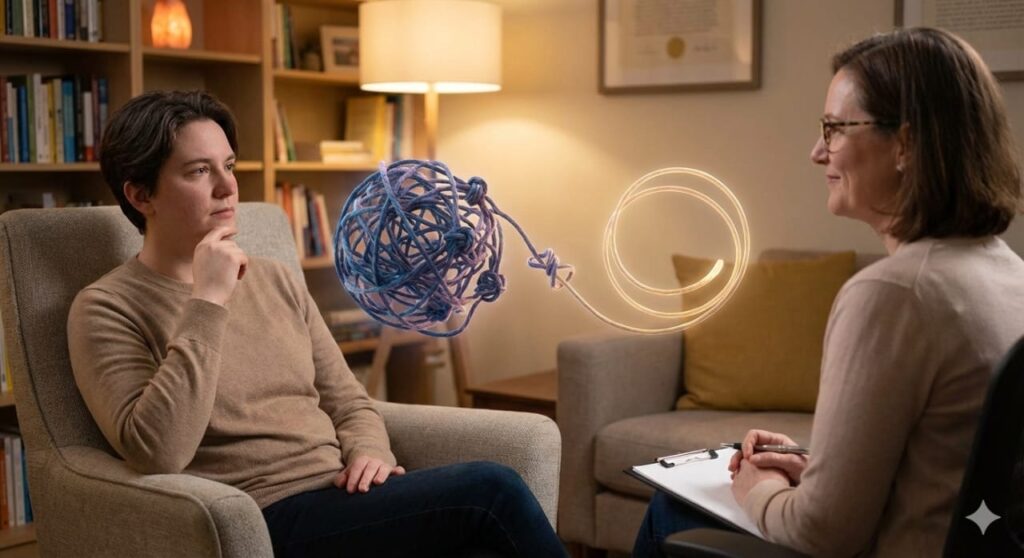
The first, and most profound, shift was moving from judgment to curiosity. My old pattern was brutal: I’d procrastinate, then spend hours berating myself for being lazy and undisciplined. In therapy, we stopped at the procrastination.
We gently unpacked it. What was the feeling right before I opened a social media app instead of the spreadsheet? Was it fear of not being good enough? Overwhelm at the project’s scale? A deep-seated rebellion against a task I resented? I discovered my procrastination wasn’t a character flaw; it was a symptom.
It was my mind’s overwhelmed, clumsy way of saying, “This feels threatening.” Once I understood the threat, the fear of judgment, the perfectionism, I could address it directly, with compassion, instead of just trying to willpower my way through it.
Therapy also helped me unearth the hidden rules that were governing my clock. I had unconscious beliefs like, “My worth is tied to my productivity,” and “Rest is what you earn only after everything is done.” No wonder I was exhausted and anxious! I was operating under a dictator.
With my therapist, I learned to identify these narratives and, slowly, write new ones. We practiced setting a timer for a focused work block, followed by a guilt-free, scheduled break. It felt unnatural at first, almost irresponsible.
But it taught my nervous system that rest wasn’t a reward for a finished masterpiece; it was a necessary part of the creative rhythm itself. I was managing my energy, not just my minutes.
Perhaps the most practical tool was learning to differentiate between urgent and important, and understanding why I constantly confused the two. In session, we’d look at my crammed schedule.
I’d see that I was saying “yes” to every external “urgent” request (a last-minute meeting, a friend’s errand) because I was afraid of conflict or disappointing people.
This constantly shoved my own important, non-urgent goals, writing, strategic thinking, learning, into the dusty corners of “someday.” Therapy gave me the safe space to role-play setting boundaries.
It bolstered the self-worth I needed to protect my time for the things that truly mattered to me, not just to others.
This work also brought a critical realization: poor time management is often a failure of transition, not planning. The block in my calendar might say “Write report 1-3 PM,” but at 1 PM, my brain was still buzzing from the frantic morning meetings.
I hadn’t scheduled the bridge. Now, I build in transition rituals, five minutes of deep breathing, a walk around the block, a cup of tea while staring out the window.
These are not wasted minutes. They are the mental air traffic control that gently lands one task before clearing the runway for the next.
Improving my time management through therapy wasn’t about finding a better app. It was about becoming a better, kinder, and more insightful manager of myself.
The clock is a neutral tool. My anxiety, my people-pleasing, my perfectionism, my old stories, those were the real tyrants stealing my time.
Now, when I look at my calendar, I see more than tasks. I see intentions. I see protected space for deep work, and I see sacred space for restoration.
I see a plan built not on the fear of falling behind, but on a commitment to living a life that feels aligned and purposeful. The hours are the same, but the person living them is fundamentally changed. I’m not just managing time anymore. I’m finally starting to inhabit it.
References
Droit‑Volet, S., & Gil, S. (2023). *Towards a psychological framework on time perception in mental health*. *Frontiers in Psychology, 14*, Article 10149727. https://pmc.ncbi.nlm.nih.gov/articles/PMC10149727/
Taylor & Francis. (2025). *Time perception – Knowledge and references*. Retrieved from https://taylorandfrancis.com/knowledge/Medicine_and_healthcare/Psychiatry/Time_perception/
Psychological Science. (n.d.). *The fluidity of time: Scientists uncover how emotions alter our sense of time*. Retrieved from https://www.psychologicalscience.org/observer/the-fluidity-of-time
TalktoAngel. (2024, December 16). *Psychology of time: Understanding time management and procrastination*. Retrieved from https://www.talktoangel.com/
Buhusi, C. V., & Meck, W. H. (2005). *What makes us tick? Functional and neural mechanisms of interval timing*. *Nature Reviews Neuroscience, 6*(10), 755–765. https://doi.org/10.1038/nrn1764