
 Posted by
 Uncover how therapy helps individuals understand and overcome Obsessive-Compulsive Disorder. Learn about Exposure and Response Prevention, cognitive techniques, and the journey to reclaiming your life from OCD.
Imagine your mind as a record player, but the needle is stuck in a single, terrifying groove. The same intrusive thought, image, or urge loops endlessly, accompanied by a crescendo of anxiety so visceral it feels like a physical alarm.
This is the lived reality of Obsessive-Compulsive Disorder. It’s not a personality quirk about tidiness; it’s a debilitating mental health condition where the brain gets trapped in a cycle of obsessions (unwanted, distressing thoughts) and compulsions (repetitive behaviors or mental acts performed to neutralize the anxiety).
The cruel genius of OCD is that the very actions meant to provide relief, the compulsions are what fuel the disorder’s power. Overcoming it is not about willpower or positive thinking; it’s about a structured, courageous therapeutic process that retrains the brain to break this cycle and tolerate uncertainty.
The journey in therapy begins with psychoeducation and normalization. A therapist helps you understand that OCD is a medical condition, not a character flaw. You learn that intrusive thoughts are universal, almost everyone has them.
The difference in OCD is not the thought itself, but the catastrophic meaning you assign to it and your brain’s heightened “error detection” response. The thought “Did I lock the door?” becomes “If I don’t check, my family will die, and it will be my unforgivable fault.”
Therapy demystifies this process, separating you from the disorder: “You are not your thoughts. You have a brain that is giving you a false alarm about danger.” This externalization, seeing OCD as a glitchy alarm system rather than a truth-teller is the first step toward empowerment.
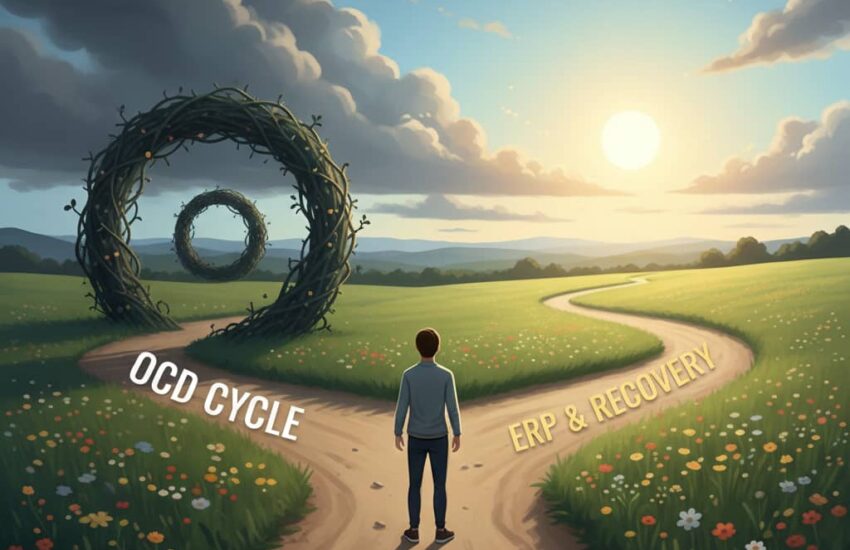
The gold-standard, evidence-based treatment for OCD is Exposure and Response Prevention. ERP is a behavioral therapy that works on a simple but profoundly challenging principle: if you stop performing the compulsion, your brain will eventually learn that the feared outcome does not occur, and the anxiety will naturally subside.
In therapy, you and your therapist collaboratively build a “fear hierarchy” a list of triggering situations ranked from least to most anxiety-provoking. You then gradually and voluntarily expose yourself to these triggers while preventing the compulsive response.
For someone with contamination fears, this might start with touching a doorknob and waiting 10 minutes before washing, gradually working up to touching a trash can. .
For someone with harm obsessions, it could involve writing a feared sentence and sitting with the anxiety without seeking reassurance. The therapist guides you through this process, ensuring it’s done safely and supportively.
The goal isn’t to eliminate anxiety immediately, but to learn through direct experience that you can tolerate the distress and that the feared catastrophe is not a reality. This process, called habituation, rewires the neural pathways, teaching the brain to stop sounding a five-alarm fire for a minor spark.
ERP is often combined with cognitive therapy techniques to address the distorted beliefs that fuel OCD. This involves challenging the “cognitive distortions” specific to OCD, such as:
* Inflated Responsibility: “I must prevent all harm.”
* Thought-Action Fusion: “Having a bad thought is morally equivalent to acting on it.”
* Intolerance of Uncertainty: “I cannot move forward unless I am 100% sure.”
The therapist helps you test these beliefs like a scientist, gathering evidence for and against them, and developing more realistic, flexible appraisals. Furthermore, therapy helps you redefine the goal.
The aim shifts from achieving “certainty” and “feeling right” to living a valued life. You learn to accept the presence of intrusive thoughts without engaging with them, a skill known as cognitive defusion. The victory is no longer the absence of anxiety, but the ability to pursue what matters to you, relationships, work, hobbies even while anxiety is present.
Overcoming OCD is a journey of reclaiming your life from a disorder that demands it. Therapy provides the roadmap and the supportive guide. It equips you with the understanding that the content of the obsession is irrelevant; the treatment is the same: face the fear, resist the compulsion, and let the anxiety pass on its own.
It’s a path that requires immense courage, but each step forward weakens OCD’s grip and strengthens your own agency. You learn that you are not broken, but stuck in a loop, and that with the right tools, you can lift the needle and choose your own music again.
References
International OCD Foundation. (2025). *OCD treatment guide: Best evidence-based therapies*. Retrieved from https://iocdf.org/ocd-treatment-guide/
Kielhofner, G., et al. (2023). A model of human occupation-based intervention for obsessive-compulsive disorder: A case study. *Cad. Ter. Ocup. (UFSCar)*. https://doi.org/10.4322/0104-4931.ctoEO2000003
American Occupational Therapy Association. (2023). *Occupational therapy for mental health conditions*. In *Occupational therapy practice framework* (4th ed.). NCBI Bookshelf. https://www.ncbi.nlm.nih.gov/books/NBK596641/
Mountain Valley Treatment Center. (2025). *Occupational therapy for anxiety and OCD: How OT is changing treatment*. Retrieved from https://mountainvalleytreatment.org/occupational-therapy-for-anxiety-and-ocd-how-ot-is-changing-treatment-at-mountain-valley/