
 Posted by
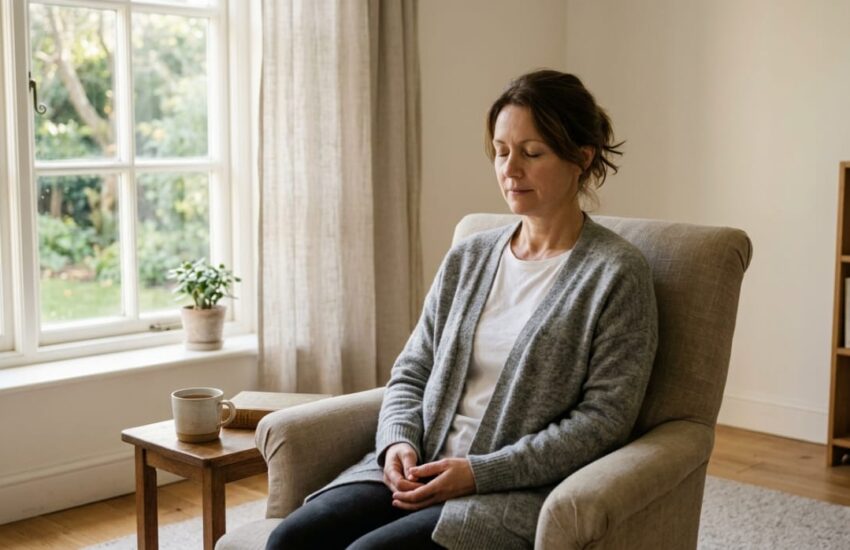
 I was skeptical. Deeply, stubbornly skeptical. My therapist suggested guided imagery for the anxiety that had taken up permanent residence in my chest, and I nodded politely while internally rolling my eyes. Visualizing peaceful scenes? Imagining my body healing? This sounded like the kind of thing you’d find in a new age gift shop, not a legitimate therapy office. But my anxiety was relentless, and I was willing to try almost anything. So I closed my eyes, took a breath, and let her voice guide me. What happened next surprised me.
Guided imagery is exactly what it sounds like, using the power of visualization to create positive changes in the body and mind. You’re guided through a mental experience that engages all your senses: not just seeing, but feeling, hearing, smelling, tasting. The images are vivid, specific, designed to evoke a particular response. Calm. Safety. Healing. Strength.
The science behind it is more solid than I expected. When you imagine something vividly, your brain activates many of the same neural pathways as when you actually experience it. Athletes use this to improve performance. Surgeons use it to practice procedures. And in clinical settings, guided imagery has been shown to reduce anxiety, manage pain, lower blood pressure, decrease stress hormones, and even support immune function.
In that first session, my therapist guided me to a place of safety, a beach I’d loved as a child. She didn’t just say “imagine the beach.” She asked me to notice the temperature of the sand, the sound of the waves, the salt in the air, the warmth of the sun on my skin. She had me picture my anxiety as something I could place in a container and set aside, something I could come back to later but didn’t need to carry right now.

By the end of those ten minutes, the tightness in my chest had loosened. My breathing was slower. My shoulders had dropped from somewhere near my ears. I wasn’t cured, but I was different. And I wanted to learn more. Guided imagery is used for many conditions. For people facing surgery, it can reduce pre-operative anxiety and speed recovery.
Cancer patients use it to manage treatment side effects, to visualize their bodies fighting illness, to find calm in the chaos of medical procedures. Chronic pain sufferers learn to change their relationship with pain, to imagine it softening, receding, transforming. People with insomnia use peaceful imagery to quiet racing thoughts and invite sleep.
The techniques vary. Sometimes it’s about creating a safe place, an internal sanctuary you can visit whenever you need refuge. Sometimes it’s about transforming symptoms, imagining pain as a color that shifts from red to blue, as a shape that dissolves, as a sound that fades. Sometimes it’s about meeting parts of yourself, the scared part, the angry part, the wounded part and offering them what they need.
My therapist taught me to create my own imagery. When anxiety spiked, I’d picture it as a storm cloud passing overhead, something I could watch without being consumed. When I couldn’t sleep, I’d imagine myself floating on calm water, supported, held. When I faced something difficult, I’d visualize myself handling it with grace, preparing my mind for what my body would need to do.
What surprised me most was how physical the response was. This wasn’t just thinking about something different; my body believed the imagery was real. My heart rate slowed. My muscles relaxed. The stress hormones that had been flooding my system began to settle. My mind was leading, but my body was following.
For people who’ve experienced trauma, guided imagery can be trickier. The mind that has learned to be vigilant, to expect danger, may not easily surrender to peaceful scenes. But with careful guidance, imagery can also help trauma survivors reclaim a sense of safety, reconnect with their bodies, and create internal resources that were unavailable before.
Guided imagery isn’t meant to replace other treatments. It’s a tool, one of many, that works alongside therapy, medication, lifestyle changes. But it’s a tool that’s always available, always portable, costing nothing and requiring no equipment. You can do it in a waiting room, in the middle of the night, in the moments before a stressful meeting.
The practice does take repetition. The first time I tried it alone, without my therapist’s voice, it felt flat. The images didn’t come easily. But I kept practicing, kept returning, and over time, the imagery became more vivid, more immediate. I could call up my safe place in seconds. I could transform tension into something manageable. The skill, like any skill, required building.
I also learned that guided imagery isn’t about pretending problems don’t exist. It’s not denial. The beach doesn’t erase the anxiety; it gives me somewhere to stand while I deal with it. The calm water doesn’t eliminate my fears; it gives me the stability to face them. The images are resources, not escape hatches.
If you’re curious about guided imagery, there are many ways to explore it. Therapists who specialize in it can offer personalized guidance. Recordings are widely available for everything from sleep to pain to performance. Even apps now offer guided imagery sessions you can use anywhere. The key is finding voices and images that resonate with you, that feel true rather than forced.
I still use guided imagery, years after that first skeptical session. Not every day, but when I need it. When anxiety threatens to overwhelm. When my body holds tension I can’t release. When I need to remember that calm is possible, that my mind can lead me there. It’s not magic, but it’s something close, a reminder that we have more power over our internal experience than we often believe.
The beach I visit in my mind isn’t the real beach. But the calm it gives me is real. The safety I find there is real. And the peace that follows me back into my life, that’s real too. There’s so much more to learn about mind-body approaches to healing. Our website is filled with articles on guided imagery, meditation, and other complementary therapies. Head over and explore, because sometimes the most powerful tools are the ones we carry inside us.
References
MacLean, M. G., & Gallagher-Thompson, D. (2020). The multiple uses of guided imagery. *Complementary Therapies in Clinical Practice*, *41*, Article 101223. https://pubmed.ncbi.nlm.nih.gov/33131625/
Rahimi, A., & Zare, H. (2023). Investigating the impact of guided imagery on stress, brain wave activity, and attentional control. *Frontiers in Psychology*, *14*, Article 1187634. https://pmc.ncbi.nlm.nih.gov/articles/PMC10346678
Li, Y., & Wang, L. (2023). Guided imagery for anxiety disorder: Therapeutic efficacy and quality of life. *Journal of Affective Disorders*, *343*, 112–120. https://pmc.ncbi.nlm.nih.gov/articles/PMC10871407
U.S. Department of Veterans Affairs. (2025, September 15). *Guided imagery*. Whole Health. https://www.va.gov/WHOLEHEALTH/cih/guided_imagery.asp
Zhang, X., & Chen, L. (2024). The effect of guided imagery on perioperative anxiety: A systematic review. *International Journal of Surgery*, *110*(3), 1523–1532. https://www.sciencedirect.com/science/article/pii/S2666262024000226