
 Posted by
 Master the art of Nonviolent Communication (NVC) to transform conflicts into understanding. Learn the 4-step process to express yourself honestly and listen with empathy. I used to think being right was the goal of any difficult conversation. I would arm myself with facts, ready to defend my position and prove my point. The result was rarely connection and often left a trail of frustration, even when I “won” the argument. It wasn’t until I encountered the work of Marshall Rosenberg and Nonviolent Communication that I understood a different way. NVC isn’t a technique for winning debates; it’s a language of the heart, a structured practice for ensuring our words become a bridge to understanding rather than a weapon for blame. It taught me that beneath every criticism is a longing, and behind every angry word is an unspoken need.
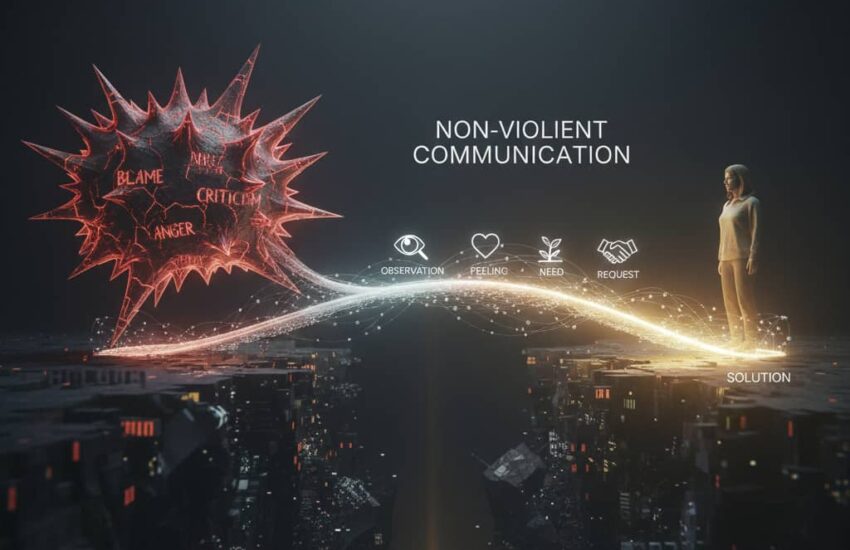
The foundation of NVC is a simple but profound shift in focus: from judging others to connecting with universal human feelings and needs. The process is built on four core components, which can be used both to express ourselves honestly and to receive others with empathy. The first step is Observation. This means stating what we see or hear without adding any evaluation or judgment. Instead of saying, “You’re always late,” which is a judgment, we say, “Our meeting was scheduled for 9 AM, and I noticed you arrived at 9:15.” This clean observation gives the other person a fact to respond to, not a character attack to defend against.
The second step is to identify and express our Feeling. This requires tapping into our emotional state in response to the observation. Using the previous example, you might feel frustrated, anxious, or disrespected. It’s crucial here to distinguish between feelings that are authentically ours and thoughts that blame the other person, such as “I feel like you don’t care about my time.” NVC encourages us to use pure feeling words: “I feel frustrated,” or “I feel anxious.”
The third, and most transformative, step is to connect that feeling to an unmet **Need**. Our feelings are indicators of whether our universal human needs are being met or not. The frustration from someone’s lateness might stem from a need for respect, consideration, or reliability. By stating, “I feel frustrated because I have a need for reliability in our plans,” we take ownership of our experience. We are no longer blaming the other person for “making us feel” a certain way. We are revealing what is important to us, which is a vulnerable and powerful invitation for connection.
The final step is to make a clear, positive, and actionable **Request**. A request is not a demand; it is a concrete proposal for how the other person could enrich our life. It should be specific and framed in the positive, asking for what we *do* want, not what we *don’t* want. Instead of “Don’t be late again,” a clear request would be, “Would you be willing to text me if you’re going to be more than five minutes late?” This gives the other person a clear path to contribute to our well-being.
The true power of NVC is that this four-part framework works in both directions. When someone speaks to us with criticism or anger, we can learn to listen for the observations, feelings, needs, and requests hidden beneath their harsh words. We can offer empathetic guesses: “Are you feeling hurt because your need for appreciation wasn’t met?” This kind of listening disarms conflict because it addresses the root cause, the unmet need, rather than getting tangled in the surface-level blame. It transforms a potential argument into a collaborative search for a strategy that meets everyone’s needs. NVC is a lifelong practice in speaking a language of life, a way of communicating that fosters respect, empathy, and a deeper understanding of ourselves and others.
References
Center for Nonviolent Communication. (n.d.). *The purpose of NVC*. Retrieved from https://www.cnvc.org/about/purpose-of-nvc
Center for Nonviolent Communication. (2023). *What is NVC?*. Retrieved from https://www.cnvc.org/learn/what-is-nvc
Bay Area Nonviolent Communication. (2019). *Basics of Nonviolent Communication*. Retrieved from https://baynvc.org/basics-of-nonviolent-communication/
Rosenberg, M. B. (2005). *Nonviolent communication: A language of life*. PuddleDancer Press. (Note: Foundational text referenced across academic sources on NVC principles and applications) [2]
Eze, J. I., Ome, I. E., & Egenti, T. N. (2021). Nonviolent communication as a tool for conflict resolution in interpersonal relationships. *International Journal of Research and Innovation in Social Science, 5*(8), 456-462. Retrieved from https://positivepsychology.com/non-violent-communication