

 Posted by
 I spent years in traditional therapy learning to talk about my feelings. I got good at it, actually. I could name my emotions, trace their origins, and analyze my patterns with the best of them. But somewhere along the way, I realized something was missing. I could talk about my sadness, but I couldn’t feel it. I could describe my anger, but it stayed locked in my chest.
My therapist called it intellectualizing, using words as a shield against real feeling. Then she suggested something unexpected. “Have you ever considered expressive therapy?” she asked. “Art, music, movement, something that bypasses the thinking brain and goes straight to the feeling brain.”
I laughed. I couldn’t draw. I couldn’t dance. I hadn’t touched an instrument since middle school band. But she wasn’t suggesting I become an artist. She was suggesting I find a way to access the parts of myself that words couldn’t reach. That suggestion opened a door I didn’t know existed.
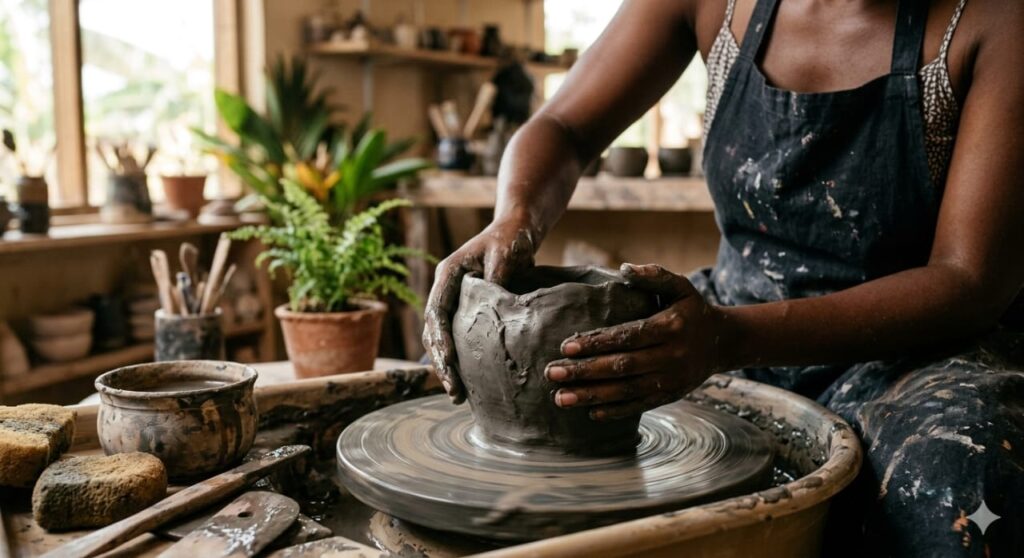
Expressive therapy is not art class. It’s not about creating something beautiful or technically skilled. Expressive therapy uses creative processes, painting, drawing, clay, music, movement, drama, writing, as a pathway to emotions that are too complex, too painful, or too deeply buried for words alone. The art becomes the language. The process becomes the healing.
The first time I tried it, I sat in front of a blank piece of paper with pastels in front of me. My therapist, a woman named Diane who specialized in expressive arts, asked me to close my eyes and think about the anxiety I’d been carrying. Then she asked me to open my eyes and just let my hands move, no planning, no judgment, no goal.
What emerged was chaos. Angry red slashes, dark scribbles, a heavy black knot in the center. It looked like nothing. It felt like everything. When I finished, I stared at that mess of color and felt something shift. That was my anxiety. Not a word describing it, but the thing itself, right there on paper. I’d externalized it, and in doing so, I’d gained some distance from it.
Diane asked simple questions. “What do you notice? If that image could speak, what would it say? What does it need?” I found myself talking to my own drawing, answering for it, discovering things about my anxiety I’d never articulated. The art had unlocked something.
That’s the magic of expressive therapy. It bypasses the logical, linear, language-based parts of the brain and speaks directly to the emotional, sensory, embodied parts. Trauma, grief, deep fear, these often live in places words can’t reach. Trying to talk them into submission is like trying to catch smoke with your hands. But give them color, sound, movement, and they can emerge, be seen, be transformed.
Different forms work for different people. Some find their voice through painting or drawing. Others need music, drumming out anger, singing grief, letting an instrument express what throats cannot. Dance and movement therapy use the body itself as the medium, releasing emotions stored in muscles and posture. Writing therapy, sometimes called poetry therapy or journal therapy, uses words too, but in a different way, less analytical, more expressive, more focused on the sensory and emotional than the cognitive.
I watched a woman in a group session who hadn’t spoken about her son’s death in years. She couldn’t. Every time she tried, her throat closed, her eyes filled, nothing came out. Then the therapist handed her clay. For forty-five minutes, she worked in silence, shaping and reshaping. What emerged was a small, rough figure, a child, maybe, or an angel, or just a shape that held her grief. When she finally spoke, she spoke through tears, but she spoke. The clay had broken the dam.
Another time, I worked with a man who’d survived combat trauma. Talk therapy had helped, but he still had nightmares, still startled at loud noises, still felt disconnected from his body. His therapist introduced him to drumming. Simple, repetitive rhythms. Something about the vibration, the physicality, the way it grounded him in his body and the present moment, it reached places his words couldn’t. He started sleeping better. His startle response softened. The drums did what years of talking hadn’t quite accomplished.
Expressive therapy isn’t about talent. This is the most important thing to understand. You don’t need to be able to draw, sing, dance, or write. In fact, people with artistic training sometimes struggle more because they’re focused on product, on skill, on whether it’s “good.” Expressive therapy is about process. It’s about letting something emerge without judgment. A stick figure can hold as much emotion as a masterpiece. A scribble can release what words cannot.
The science backs this up. Creative expression activates different neural pathways than language. It engages the limbic system, where emotions live. It reduces cortisol, the stress hormone. It increases dopamine, the feel-good neurotransmitter. It integrates the left and right hemispheres of the brain, helping us process experience more holistically. It’s not just nice; it’s neurological.
In group settings, expressive therapy builds connection in unique ways. Sharing art you’ve created is vulnerable in a way that sharing words sometimes isn’t. There’s something about showing rather than telling that cuts through pretense. Groups that create together, a communal mural, a shared rhythm, a collective poem, often bond more deeply than groups that only talk together.
For children, expressive therapy is often the only therapy that works. Kids don’t have the vocabulary or cognitive development to process complex emotions through talk. But give them crayons, puppets, sand trays, and they’ll show you exactly what’s going on inside. Play is their language, and expressive therapy speaks it fluently.
I still do expressive therapy sometimes, years after that first session with pastels. Not because I’m in crisis, but because it keeps me connected to parts of myself that words can’t reach. When I feel stuck, blocked, or just vaguely off, I pull out art supplies and let my hands move. Something always emerges. Something always shifts.
If you’re in therapy and feel like you’ve plateaued, or if you’re considering therapy but talk feels intimidating, expressive therapy might be worth exploring. Look for a therapist trained in expressive arts, they’ll have credentials like REAT (Registered Expressive Arts Therapist) or specific training in modalities like art therapy, music therapy, or dance/movement therapy. Ask about their approach. See if it resonates.
You don’t need to be an artist. You just need to be human, with all the messy, complicated, beautiful feelings that come with it. Expressive therapy offers a way to meet those feelings not with analysis, but with presence. Not with words, but with color and sound and movement and clay. Not by thinking about your emotions, but by touching them, shaping them, letting them be seen.
Sometimes words aren’t enough. That’s okay. There are other languages. There’s so much more to learn about different approaches to therapy and healing. Our website is filled with articles on modalities, techniques, and personal growth. Head over and explore, because the right approach for you might be something you’ve never considered.
References
King, J. L. (2016). *Expressive arts therapy for traumatized children and adolescents: A four-phase model*. Routledge. https://doi.org/10.4324/9781315666581
Malchiodi, C. A. (Ed.). (2020). *Trauma and expressive arts therapy: Brain, body, and imagination in the healing process*. Guilford Press.
National Board for Certified Counselors. (2024, February 20). *Expressive arts therapy can empower clients of all ages*. NBCC. https://www.nbcc.org/resources/nccs/newsletter/expressive-arts-therapy
PositivePsychology.com. (2022, October 15). *Expressive arts therapy: 15 creative activities and techniques*. https://positivepsychology.com/expressive-arts-therapy/
University Hospitals. (2024, January 13). *How expressive therapies help patients heal*. https://www.uhhospitals.org/blog/articles/2024/01/how-expressive-therapies-help-patients-heal