
 Posted by
 I didn’t believe in magic. Not the fairy tale kind, anyway. I believed in hard work, in talk therapy, in the slow grind of self-improvement. After years of traditional therapy for anxiety and a history of relational trauma, I’d made progress. Real progress. But there was still something stuck, something words couldn’t reach, a part of me that stayed guarded no matter how many sessions I sat through.
Then a friend suggested equine-assisted therapy. I laughed. Horses? I was afraid of horses. They were huge, unpredictable, intimidating. The last thing I needed was another thing to be anxious about. But I was desperate enough to try anything.
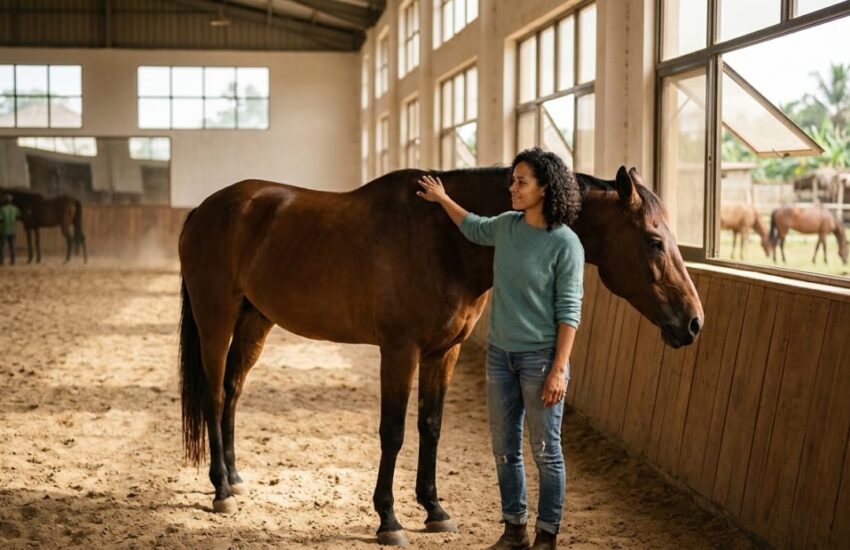
The first time I walked into the arena, I kept my distance. The horses stood on the other side, large and indifferent, swishing tails and flicking ears. My therapist, a woman named Ellen who’d been doing this work for decades, didn’t make me approach them. She just invited me to stand there, to notice what I felt, to observe without doing anything.
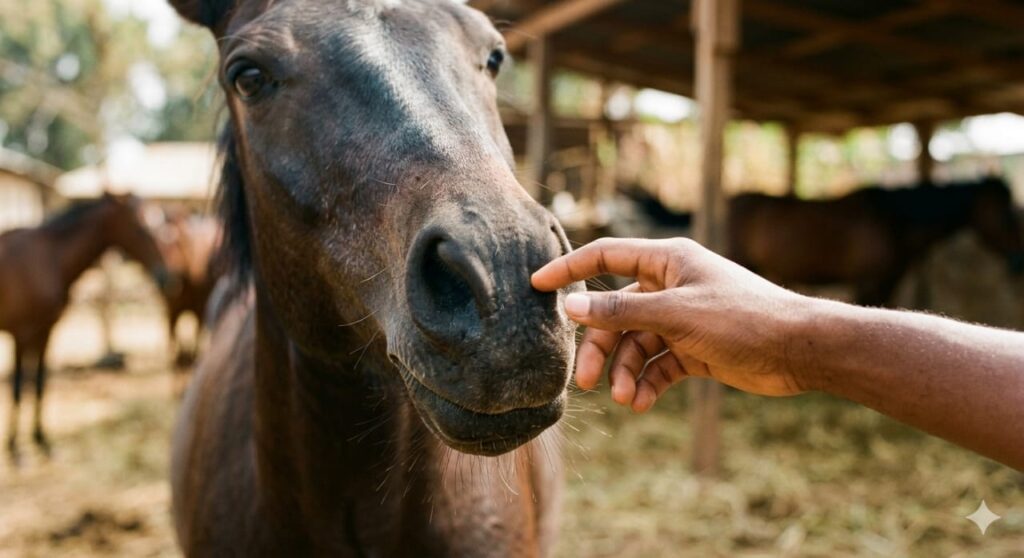
What I felt was terror. My heart raced, my palms sweated, every instinct screamed “danger.” But Ellen didn’t push. She just asked questions. “What do you notice in your body? What do you think the horses notice about you?” Slowly, over that first session and the ones that followed, something shifted. The horses became teachers. And I began to understand what equine-assisted therapy really means.
Let me start with why horses. Why not dogs or cats or any other animal? Horses are uniquely suited for this work because they are prey animals, exquisitely sensitive to their environment. They read non-verbal cues constantly, body language, energy, intention, because their survival depends on it. A horse knows instantly whether you’re calm or agitated, congruent or fake, trustworthy or not. And they respond accordingly, reflecting back exactly what you’re bringing into their space.
This makes them powerful mirrors. If you approach a horse with anxiety, the horse becomes anxious. If you approach with aggression, the horse pulls away. If you approach with authentic calm and clear intention, the horse softens and approaches. There’s no hiding with a horse. They see through the masks we wear and respond to what’s really there.
For someone like me, who’d spent years hiding behind a carefully constructed facade, this was both terrifying and liberating. The horses didn’t care about my words. They didn’t care about my explanations or justifications. They cared about how I showed up in their presence. And they taught me more about myself in an hour than months of talk therapy had.
The work isn’t about riding. Most equine-assisted therapy happens on the ground. You might groom a horse, lead it through an obstacle course, or simply stand nearby while the therapist asks questions about what’s happening. The horse becomes a co-therapist, responding to your internal state and providing immediate feedback.
I remember one session where I was trying to lead a horse named Tucker through a simple path. He kept stopping, refusing to move. Ellen asked what I thought was happening. I didn’t know. She asked how I was feeling. Frustrated, I said. Annoyed. Like he was being difficult on purpose. Ellen nodded and suggested that maybe Tucker was picking up on something else, my tension, my need to control, my fear of not doing it right. “Horses don’t respond to what you want them to do,” she said. “They respond to who you are in the moment.”
I stood there, hand on Tucker’s halter, and realized she was right. I wasn’t leading him; I was dragging him, just like I dragged myself through life, full of tension and effort and no trust. I took a breath. I softened my grip. I dropped my shoulders. Tucker turned his head and looked at me, really looked, and then took a step forward. It was the smallest thing, but it felt like a miracle.
Another session, I worked with a mare named Bella who was known for being aloof. She kept her distance from everyone, including me. Ellen asked me to just be present, not to try to connect, not to force anything. I stood in the arena for twenty minutes while Bella grazed nearby, occasionally glancing my way. It was uncomfortable at first, all that nothing happening. But gradually, I started to notice things. The way Bella would move closer when I relaxed, pull away when I tensed. The way my own anxiety about being rejected was creating the very rejection I feared.
By the end of that session, Bella was standing beside me, her head lowered, breathing softly. She hadn’t come to me because I’d done anything special. She’d come because I’d finally stopped trying so hard. That lesson, about connection, about letting go, about the difference between forcing and allowing, has stayed with me ever since.
Equine-assisted therapy is used for all kinds of issues: trauma, anxiety, depression, addiction, relationship problems, eating disorders. It’s particularly powerful for people who have trouble trusting, who’ve been hurt in relationships, who’ve learned that words can be used to manipulate and deceive. Horses don’t manipulate. They don’t lie. They respond to what’s real, which makes them safe in a way that humans sometimes aren’t.
The therapists who do this work are specially trained. They’re not just horse people who decided to do therapy; they’re mental health professionals who’ve added equine techniques to their toolkit. They know how to read both horse and human, how to facilitate the interactions, how to help you make meaning of what happens in the arena.
For children and teens, equine therapy can be especially powerful. Kids who won’t talk to a therapist will open up to a horse. They’ll groom, lead, care for the animal, and in the process, they’ll learn about boundaries, trust, empathy, and self-regulation. The horse doesn’t judge, doesn’t lecture, doesn’t have expectations. It just offers presence and honest feedback.
I did equine therapy for about eight months. By the end, I wasn’t afraid of horses anymore. More importantly, I wasn’t as afraid of myself. The horses had shown me parts of myself I’d kept hidden, my fear, my control, my longing for connection. And they’d shown me that those parts weren’t shameful. They were just human.
If you’re considering therapy and traditional approaches haven’t quite reached the stuck places, equine-assisted therapy might be worth exploring. You don’t need horse experience. You don’t need to ride. You just need to show up, open to whatever happens, and let these remarkable animals do what they’ve done for thousands of years, help humans connect with themselves and each other.
There’s something about horses that reaches beyond words. Maybe it’s their size, their presence, their ancient partnership with humans. Maybe it’s simply that they’re honest in a world full of spin. Whatever it is, it worked for me in ways I never expected. And if you’re stuck, really stuck, it might work for you too.
There’s so much more to learn about alternative and complementary approaches to mental health. Our website is filled with articles on therapy modalities, healing practices, and personal growth. Head over and explore, because healing comes in many forms, and the right approach for you might be something you’ve never considered.
References
Nieforth, L. O., Craigon, P. J., Fournier, C., & Hodgson, D. (2023). Equine-assisted therapy effectiveness in improving emotion regulation, self-efficacy, self-esteem and sense of coherence: A systematic review and meta-analysis. *Frontiers in Psychology*, *14*, Article 1130178. https://pmc.ncbi.nlm.nih.gov/articles/PMC10576391/
Purdue University College of Veterinary Medicine. (n.d.). *How equine communication transforms trauma healing*. https://vet.purdue.edu/discovery/nieforth/research/articles/how-equine-communication-transforms-trauma-healing.php
Columbia University Department of Psychiatry. (2021, November 7). *Horse therapy helps veterans overcome trauma*. https://www.columbiapsychiatry.org/news/horse-therapy-helps-veterans-overcome-trauma
American Addiction Centers. (2025, May 22). *What is equine-assisted therapy? Equine therapy near you*. https://americanaddictioncenters.org/therapy-treatment/animal-assisted/equine-therapy
EAGALA (Equine Assisted Growth and Learning Association). (2024, November 24). *What are the different equine therapy benefits*. https://www.eagala.org/blog/equine-therapy-benefits/