
 Posted by
 For years after the assault, I could not talk about it. I tried. I sat in therapists’ offices and stared at the wall, words stuck somewhere between my throat and my chest. My mind had built a wall around the memory, and no amount of talking could break through. What I did not understand was that the memory was not stored in my mind. It was stored in my body. My shoulders carried it. My hips carried it. My breath carried it. And my body was the only way out.
Dance/movement therapy is the psychotherapeutic use of movement to promote emotional, social, cognitive, and physical integration. For trauma survivors, it offers something that talk therapy often cannot. Trauma is not just a story. It is a physiological experience. The body goes into fight, flight, or freeze, and those responses get trapped in the muscles, the nervous system, and the breath. Movement therapy works directly with those trapped responses, releasing them through intentional, guided motion.
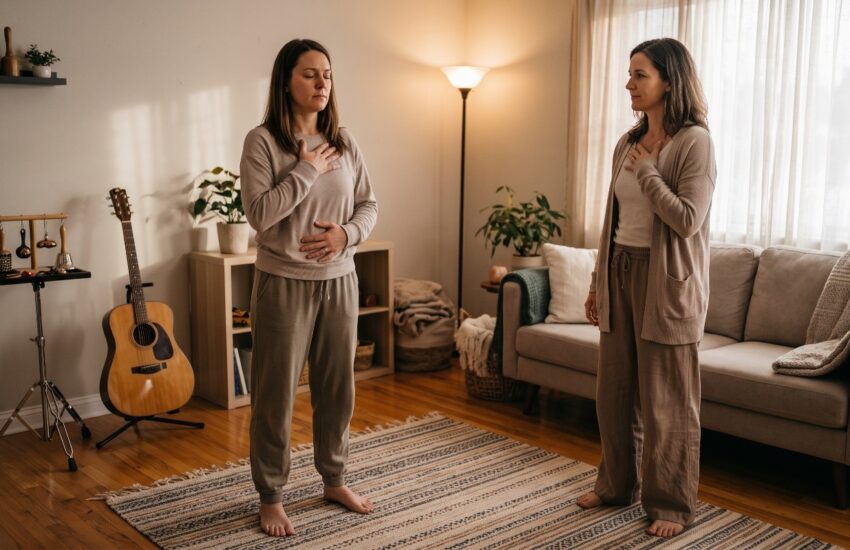
My first session was terrifying. The therapist asked me to close my eyes and notice where I felt tension in my body. I felt it everywhere. My jaw was clenched. My fists were tight. My stomach was knotted. She did not ask me to relax. She asked me to simply notice. That was the first step. Trauma survivors often live disconnected from their bodies because the body feels like a dangerous place. Noticing was the beginning of reconnection.

She then asked me to push against a wall. Not gently. With force. I hesitated. I was not an aggressive person. But she encouraged me. I pushed. I pushed harder. My arms shook. My breath quickened. And then something broke loose. I started to cry. Not from sadness. From release. My body had been holding a fight that never happened, and it finally had permission to move. That was the day I understood that healing was not just about talking. It was about moving.
Over the following months, we worked with rhythm, breath, and gesture. She taught me to use my breath to regulate my nervous system. She taught me to ground myself through my feet. She taught me to notice when I was dissociating and to use small movements to bring myself back. She gave me a vocabulary for sensations that I had never had before. Tight. Hollow. Buzzing. Frozen. Naming them reduced their power.
We also worked with boundaries. Trauma often involves a violation of boundaries, and survivors often lose the ability to sense where their boundaries are. My therapist used movement to help me rebuild that sense. She would ask me to walk toward her until I felt uncomfortable, then stop. I learned to feel the exact moment when my body said no. I learned to trust that signal. I learned to say stop.
Group movement therapy added another layer of healing. Moving with others who had experienced trauma created a sense of shared understanding that words could not. We did not have to explain ourselves. We moved together. We held space for each other. We witnessed each other without judgment. That collective presence was profoundly regulating.
The research supports what I experienced. Dance/movement therapy has been shown to reduce symptoms of post-traumatic stress disorder, including intrusion, avoidance, and hyperarousal. It improves body awareness, emotional regulation, and interpersonal connection. It is particularly effective for trauma survivors because it bypasses the language centers of the brain and works directly with the sensory and motor systems where trauma lives.
I still have difficult days. Trauma does not disappear completely. But I am no longer trapped in my body. I can feel my feet on the ground. I can breathe into my belly. I can move when I feel stuck. I can say no when something feels wrong. My body is no longer a prison. It is a home.
References
Harris, D. A. (2007). Dance/movement therapy approaches to fostering resilience and recovery among African adolescent torture survivors. *Torture: Journal on Rehabilitation of Torture Victims and Prevention of Torture, 17*(2), 134–155.
Harris, D. A. (2007). Pathways to embodied empathy and reconciliation: Former boy soldiers in a dance/movement therapy group in Sierra Leone. *Intervention, 5*(3), 203–231.
Levine, B., & Land, H. M. (2016). A meta-synthesis of qualitative findings about dance/movement therapy for individuals with trauma. *Qualitative Health Research, 26*(3), 330–344.
Mills, L., & Daniluk, J. C. (2002). Her body speaks: The experience of dance therapy for women survivors of child sexual abuse. *American Journal of Dance Therapy, 24*(2), 77–93.
Dieterich-Hartwell, R. (2020). Dance/movement therapy: A whole-person approach to working with trauma and building resilience. *American Journal of Dance Therapy, 42*(1), ಅನು? 1–18. [https://doi.org/10.1007/s10465-020-09335-6](https://doi.org/10.1007/s10465-020-09335-6)
Bernstein, B. (2019). Empowerment-focused dance/movement therapy for trauma recovery. *American Journal of Dance Therapy, 41*(1), 193–213.
Kirk, A. E. (2024). The use of dance and movement for the embodied healing of interpersonal trauma in women and girls: A systematic review. *Trauma, Violence, & Abuse*. [https://doi.org/10.1177/15248380241243399](https://doi.org/10.1177/15248380241243399)