

 Posted by
 I used to think dissociation was something that only happened in movies. People with multiple personalities, dramatic blackouts, a complete loss of self. I had no idea that dissociation is a spectrum, that it can be subtle, that it can look like daydreaming or zoning out or feeling disconnected from your own body. I had no idea that I had been dissociating for years.
The first time I noticed something was wrong, I was driving home from work. I had no memory of the last ten minutes. I was on autopilot, my body going through the motions while my mind was somewhere else entirely. I told myself I was just tired. Then it happened again. And again. I started finding notes in my handwriting that I did not remember writing. I would walk into a room and forget why I was there, not occasionally but constantly. I was losing time, and I was terrified.
What I was experiencing was a dissociative disorder. Dissociative disorders are conditions that involve disruptions in consciousness, memory, identity, emotion, perception, body representation, motor control, or behavior. The disruptions can be sudden or gradual, transient or chronic.
The most well-known dissociative disorder is dissociative identity disorder, formerly called multiple personality disorder. It is characterized by the presence of two or more distinct personality states, accompanied by gaps in memory. But most dissociative disorders are not that dramatic. Dissociative amnesia is the inability to recall important personal information, often after a traumatic event. Depersonalization disorder involves feeling detached from your own body, as if you are watching yourself from outside. Derealization disorder involves feeling that the world around you is unreal, dreamlike, or distorted.
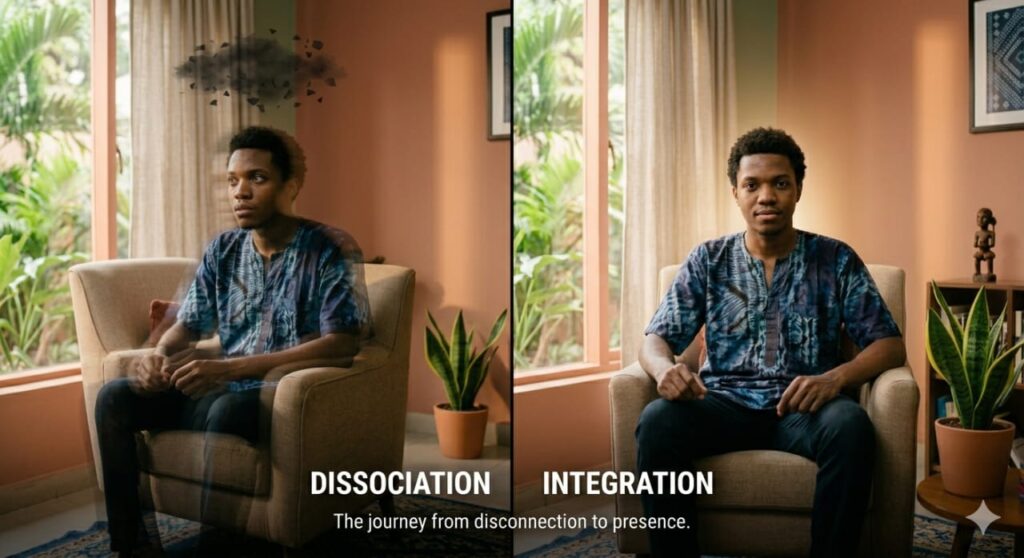
For me, it was depersonalization. I felt like I was watching my life from a distance, a spectator in my own body. I was going through the motions, but I was not present. My therapist asked me when it started, and I had to think. It started after my father died. I was sixteen. I did not know how to process the grief, so I left my body instead. I stayed gone for twenty years.
The dissociative disorders often begin after overwhelming stress or trauma. They are the brain’s attempt to protect itself from experiences too painful to fully process. The dissociation becomes a coping mechanism, a way to survive. But what starts as protection eventually becomes a prison.
Diagnosing dissociative disorders is difficult. People often do not know they are dissociating. They complain of depression, anxiety, mood swings, or memory problems. They are frequently misdiagnosed for years before receiving the correct diagnosis. I was treated for depression, anxiety, and bipolar disorder before anyone thought to ask about dissociation. When my therapist finally did the screening, my scores were off the charts.
Treatment for dissociative disorders focuses on integrating the dissociated parts of experience. The first step is stabilization, which involves grounding techniques to keep you present. I learned to notice my feet on the floor, the weight of my body in the chair, the sensation of my breath moving in and out. I learned to say my name out loud, to look around the room and name what I saw. These simple tools anchored me in the present and slowly brought me back into my body.
The second step is processing trauma. This is delicate work because you cannot process what you cannot access. Dissociation is the mind’s way of hiding painful memories. Therapy must be slow and careful, not rushed. I spent years building trust with my therapist before we even touched my trauma. When we finally did, it was hard. I dissociated during sessions. I had panic attacks. I wanted to run. But my therapist did not let me run. She held space for me, and I slowly began to integrate the parts of myself that had been split off.
The final step is integration and connection. This means healing the relationships that trauma damaged, learning to trust others and yourself, and building a life that feels real. I am not fully integrated. Dissociation still visits sometimes. But I no longer lose hours to it. I am present for most of my life now. My husband knows the signs. He calls me back when I drift. I have a life I want to be present for.
If you recognize yourself in this story, please do not wait twenty years to get help. Dissociative disorders are treatable. The right therapist, the right approach, and the right support can bring you back to yourself. You can be present. You can be whole. It just takes time, patience, and the courage to feel what you have been trying to escape.
There is so much more to learn about dissociation and healing from trauma. Our website is filled with articles on dissociative disorders, grounding techniques, and finding the right therapist. Head over and explore, because you deserve to feel real again.
References
American Psychiatric Association. (2023, December 31). *Dissociative disorders*. https://www.psychiatry.org/patients-families/dissociative-disorders
Mayo Clinic. (2023, August 30). *Dissociative disorders: Symptoms and causes*. https://www.mayoclinic.org/diseases-conditions/dissociative-disorders/symptoms-causes/syc-20355215
Mayo Clinic. (2023, August 30). *Dissociative disorders: Diagnosis and treatment*. https://www.mayoclinic.org/diseases-conditions/dissociative-disorders/diagnosis-treatment/drc-20355221
Merck Manual Consumer Version. (2025, July 8). *Overview of dissociative disorders*. https://www.merckmanuals.com/en-ca/home/mental-health-disorders/dissociative-disorders/overview-of-dissociative-disorders
National Institute of Mental Health. (n.d.). *Dissociative disorders*. https://www.nami.org/types-of-conditions/dissociative-disorders/